“As a contrast to the Bach of pure music I present the Bach who is a poet and painter in sound. In his music and in his texts he expresses the emotional as well as the descriptive with great vitality and clarity. Before all else he aims at rendering the pictorial in lines of sound. He is even more tone painter than tone poet. His art is nearer to that of Berlioz than to that of Wagner. If the text speaks of drifting mists, of boisterous winds, of roaring rivers, of waves that ebb and flow, of leaves falling from the tree, of bells that toll for the dying, of the confident faith that walks with firm steps or the weak faith that falters, of the proud who will be debased and the humble who will be exalted, of Satan rising in rebellion, of angels on the clouds of heaven, then one sees and hears all this in his music. Bach has, in fact, his own language of sound. There are in his music constantly recurring rhythmical motives expressing peaceful bliss, lively joy, intense pain, or sorrow sublimely borne. The impulse to express poetic and pictorial concepts is the essence of music. It addresses itself to the listener's creative imagination and seeks to kindle in him the feelings and visions with which the music was composed. But this it can do only if the person who uses the language of sound possesses the mysterious faculty of rendering thoughts with a superior clarity and precision. In this respect Bach is the greatest of the great.”
Quote by Albert Schweitzer
Work
Out of My Life and Thought
Browse quotes and source details for this work. more
Author
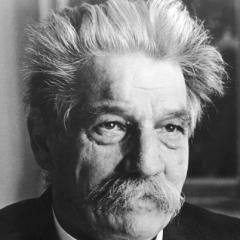
Albert Schweitzer
Albert Schweitzer, born on January 14, 1875, and died on September 4, 1965, was a German theologian, musician, philosopher, and physician. He is renowned for his missionary work in Africa. more
You May Also Like
Source: Existentialism is a Humanism
“How loud did the music have to be to drown out her thoughts?”
Source: The Sorcerer Heir
Source: The Confessions of an English Opium-Eater and Other Writings
Source: The Lewis and Clark of The Ozarks
Source: The Wolves in the Walls
Source: Capitalist Realism: Is There No Alternative?