“A dreaded society is not a civilized society. The most progressive and powerful society in the civilized sense, is a society which has recognized its ethos, and come to terms with the past and the present, with religion and science. With modernism and mysticism, with materialism and spirituality; a society free of tension, a society rich in culture. Such a society cannot come with hocus-pocus formulas and with fraud. It has to flow from the depth of a divine search.”
Quote by Zulfikar Ali Bhutto
Author
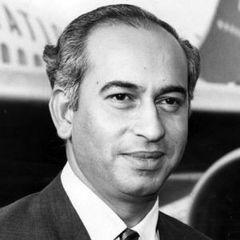
Zulfikar Ali Bhutto
Zulfikar Ali Bhutto (January 5, 1928 – April 4, 1979) was a Pakistani politician and the founder of the Pakistan Peoples Party (PPP). He served as President of Pakistan from 1971 to 1973 and as Prime Minister from 1973 to 1977. Born into a wealthy Sindhi family, Bhutto was educated at the University of California, Berkeley and Oxford University. He entered politics after returning to Pakistan and established the PPP in 1967, advocating "Islamic socialism." During his tenure, he oversaw the independence of Bangladesh in 1971 and introduced the 1973 Constitution, establishing Pakistan's parliamentary system. Bhutto implemented land reforms and industrialization policies. He was overthrown in a military coup in 1977 and executed in 1979 after being convicted of murder. His legacy remains controversial, but he is remembered as a champion of democracy in Pakistan. more
You May Also Like
Source: Autobiography of John Stuart Mill
“Courage to be who you are is the cousin of loving the Divine, yourself and others.”
Source: An Essay on the Nature and Conduct of the Passions and Affections
Source: The Descent of Man, and Selection in Relation to Sex
Source: Ancient Wisdom, Modern World: Ethics for the New Millennium