Quotessence
Home / Quotes / Quote by Thomas Jefferson

Quote by Thomas Jefferson

Work

Memoirs, correspondence and private papers of Thomas Jefferson, ed. by T.J. Randolph

Memoirs, correspondence and private papers of Thomas Jefferson offers a comprehensive collection of the personal writings of the third President of the United States. The volume includes Jefferson's reflections on his life, his extensive correspondence with contemporaries, and his private papers, all edited by T.J. Randolph. more

Author
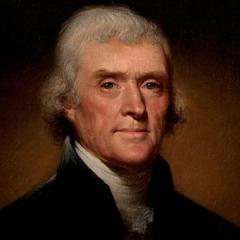
Thomas Jefferson
Thomas Jefferson

Thomas Jefferson was the third President of the United States, a distinguished politician, philosopher, architect, and scientist. He was born on April 13, 1743, and died on July 4, 1826. Jefferson advocated for democracy and freedom in politics and was one of the main authors of the Declaration of Independence. His political ideas had a profound impact on the founding and development of the United States. more

You May Also Like

“If men of wisdom and knowledge, of moderation and temperance, of patience, fortitude and perseverance, of sobriety and true republican simplicity of manners, of zeal for the honour of the Supreme Being and the welfare of the commonwealth; if men possessed of these other excellent qualities are chosen to fill the seats of government, we may expect that our affairs will rest on a solid and permanent foundation.”

“It gives me real concern to observe ... that you should think it necessary to distinguish between my personal and public character, and confine your esteem to the former.”

“As you sometimes swear by him that made you, I conclude your sentiments do not correspond with his, in that which is the basis of the doctrine you both agree in: and this makes it impossible to imagine whence this congruity between you arises. "To grant that there is a supreme intelligence who rules the world and has established laws to regulate the actions of his creatures; and still to assert that man, in a state of nature, may be considered as perfectly free from all restraints of law and government, appears to a common understanding altogether irreconcilable.”

“Good and wise men, in all ages, have embraced a very dissimilar theory. They have supposed that the deity, from the relations we stand in to himself and to each other, has constituted an eternal and immutable law, which is indispensably obligatory upon all mankind, prior to any human institution whatever. This is what is called the law of nature....Upon this law depend the natural rights of mankind.”

“I firmly believe this ... that without His concurring aid we shall succeed in this political building no better, than the builders of Babel: We shall be divided by our little partial local interests; our projects will be confounded, and we ourselves shall become a reproach and bye word down to future ages. And what is worse, mankind may hereafter from this unfortunate instance, despair of establishing governments by human wisdom and leave it to chance, war and conquest.”

“In offering to you, my countrymen, these counsels of an old and affectionate friend, I dare not hope they will make the strong and lasting impression I could wish; that they will control the usual current of the passions, or prevent our nation from running the course which has hitherto marked the destiny of nations. ... moderate the fury of party spirit, to warn against the mischiefs of foreign intrigue, to guard against the impostures of pretended patriotism; this hope will be a full recompense for the solicitude for your welfare, by which they have been dictated.”

“Thank God! we are in the full enjoyment of all these privileges. But can we be taught to prize them too much? or how can we prize them equal to their value, if we do not know their intrinsic worth, and that they are not a gift bestowed upon us by other men, but a right that belongs to us by the laws of God and nature?”

“Since they are our right, let us be vigilant to preserve them uninfringed, and free from encroachments. If animosities arise, and we should be obliged to resort to party, let each of us range himself on the side which unfurls the ensigns of public good. Faction will then vanish, which, if not timely suppressed, may overturn the balance, the palladium of liberty, and crush us under its ruins.”