Quotessence
Home / Quotes / Quote by Abraham Lincoln

Quote by Abraham Lincoln

“[If not re-elected in 1864] then it will be my duty to so co-operate with the President elect, as to save the Union between the election and the inauguration; as he will have secured his election on such ground that he can not possibly save it afterwards.”

Quote by Abraham Lincoln

Work

Conversations With Lincoln

This book presents a series of imagined conversations between the 16th President of the United States, Abraham Lincoln, and notable individuals from his time. The discussions explore a range of historical topics and reflect Lincoln's thoughts and perspectives on the issues of his era. more

Author
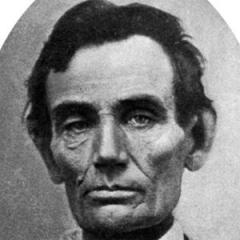
Abraham Lincoln
Abraham Lincoln

Abraham Lincoln was the 16th President of the United States, serving from 1861 to 1865. He was a pivotal leader during the American Civil War, dedicated to preserving the unity of the nation and the abolition of slavery. Lincoln is renowned for his noble character and exceptional leadership. more

You May Also Like

“In using the strong hand, as now compelled to do, the government has a difficult duty to perform. At the very best, it will by turns do both too little and too much. It can properly have no motive of revenge, no purpose to punish merely for punishment's sake. While we must, by all available means, prevent the overthrow of the government, we should avoid planting and cultivating too many thorns in the bosom of society.”

“By academic freedom I understand the right to search for truth and to publish and teach what one holds to be true. This right implies also a duty: one must not conceal any part of what on has recognized to be true. It is evident that any restriction on academic freedom acts in such a way as to hamper the dissemination of knowledge among the people and thereby impedes national judgment and action.”

“All our thoughts and concepts are called up by sense-experiences and have a meaning only in reference to these sense-experiences. On the other hand, however, they are products of the spontaneous activity of our minds; they are thus in no wise logical consequences of the contents of these sense-experiences. If, therefore, we wish to grasp the essence of a complex of abstract notions we must for the one part investigate the mutual relationships between the concepts and the assertions made about them; for the other, we must investigate how they are related to the experiences.”

“The state exists for man, not man for the state. The same may be said of science. These are old phrases, coined by people who saw in human individuality the highest human value. I would hesitate to repeat them, were it not for the ever recurring danger that they may be forgotten, especially in these days of organization and stereotypes.”