Quotessence
Home / Quotes / Quote by Hermann Hesse

Quote by Hermann Hesse

Author

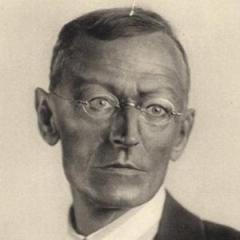
Hermann Hesse
Hermann Hesse

Hermann Hesse was a German poet and novelist, born on July 2, 1877, and died on August 9, 1962. Known for his profound psychological descriptions and exploration of human nature, his works include classics such as 'Steppenwolf' and 'The Glass Bead Game'. more

You May Also Like

“Yet I was a fool to fancy for a moment that she valued Edgar Linton's attachment more than mine -- If he love with all the powers of his puny being, he couldn't love as much in eighty years, as I could in a day. And Catherine has a heart as deep as I have; the sea could be as readily contained in that horse-trough, as her whole affection be monopolized by him -- Tush! He is scarcely a degree dearer to her than her dog, or her horse -- It is not in him to be loved like me, how can she love in him what he has not?”

“I have no pity! I have no pity! The more worms writhe, the more I yearn to crush out their entrails! It is a moral teething, and I grind with greater energy, in proportion to the increase of pain.”

“Sam Vimes could parallel process. Most husbands can. They learn to follow their own line of thought while at the same time listening to what their wives say. And the listening is important, because at any time they could be challenged and must be ready to quote the last sentence in full. A vital additional skill is being able to scan the dialogue for telltale phrases such as "and they can deliver it tomorrow" or "so I've invited them for dinner?" or "they can do it in blue, really quite cheaply.”

“This concern with the basic condition of freedom -- the absence of physical constraint -- is unquestionably necessary, but is not all that is necessary. It is perfectly possible for a man to be out of prison and yet not free -- to be under no physical constraint and yet to be a psychological captive, compelled to think, feel and act as the representatives of the national State, or of some private interest within the nation, want him to think, feel and act.”

“I will find you," he whispered in my ear. "I promise. If I must endure two hundred years of purgatory, two hundred years without you - then that is my punishment, which I have earned for my crimes. For I have lied, and killed, and stolen; betrayed and broken trust. But there is the one thing that shall lie in the balance. When I shall stand before God, I shall have one thing to say, to weigh against the rest." His voice dropped, nearly to a whisper, and his arms tightened around me. Lord, ye gave me a rare woman, and God! I loved her well.”