Quotessence
Home / Quotes / Quote by James E. Faust

Quote by James E. Faust

Author

James E. Faust
James E. Faust

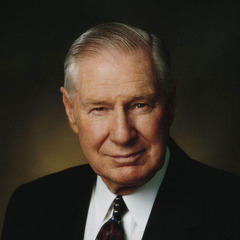
James E. Faust was a distinguished lawyer known for his remarkable contributions to the legal field. Born on July 31, 1920, and passing away on August 10, 2007, Faust made a significant impact through his profound legal knowledge and extensive practical experience, setting an example for the legal community. more

You May Also Like

“But no one can blink at the fact that in this land, and in other lands across the world, there is an epidemic affecting the lives of millions of youth. It is a sickness that comes of a loss of values, of an abandonment of moral absolutes. The virus which has infected them comes of leaderless families, leaderless schools, leaderless communities. It comes of an attitude that says, "We will not teach moral values. We will leave the determination of such to the individual."”

“The scriptures, for example, discredit an ancient philosophy that has come back into vogue in our day-the philosophy of Korihor that there are no absolute moral standards, that "every man prospers according to his genius, and that every man conquers according to his strength; and whatsoever a man does is no crime" and "that when a man is dead, that is the end thereof".”

“One reason for the decline in moral values is that the world has invented a new, constantly changing and undependable standard of moral conduct referred to as "situational ethics." Now, individuals define good and evil as being adjustable according to each situation; this is in direct contrast to the proclaimed God-given absolute standard: "Thou shalt not!"-as in "Thou shalt not steal".”

“The absolutist lays down the law, but the relativist hears only roaring and bawling. Or, when the relativist voice, as it is heard from philosophers such as Nietzsche or James, itself starts to grate and sounds shrill, as it often does, and when the relativist then offers concessions, the absolutist hears only insincerity. The war of words can often turn into a dialogue of the deaf, and this too if part of its power to arouse outrage and fury.”

“It is sometimes said that one of the casualties of the general suspicion and mistrust that permeated the old Soviet Union was that the distinction between truth and other motivations to believe tended to break down. Upon hearing a purported piece of information, the reaction was not 'Is this true?' but 'Why is this person saying this? - What machinations or manipulations are going on here?' The question of truth did not, as it were, have the social space in which it could breath.”