Quotessence
Home / Quotes / Quote by Christopher Paolini

Quote by Christopher Paolini

“Saphira: The worth is in the act. Your worth halts when you surrender the will to change and experience life. But options are before you; choose one and dedicate yourself to it. The deeds will give you new hope and purpose. Eragon: But what can I do? Saphira: The only true guide is your heart. Nothing less than its supreme desire can help you.”

Quote by Christopher Paolini

Book:Eragon

Work

Eragon

Eragon is a fantasy novel that tells the story of a young boy named Eragon, who finds a mysterious dragon egg in the forest. As he hatches the egg, Eragon becomes the rider of the dragon, Saphira. The novel follows Eragon's adventures as he grows into his new role and learns about the complex world of magic and politics that surrounds him. more

Author

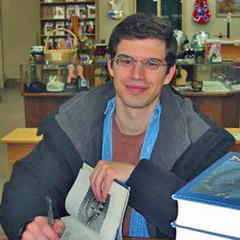
Christopher Paolini
Christopher Paolini

Christopher Paolini is an American author who gained fame with his fantasy novel series, 'The Inheritance Cycle'. Born on November 17, 1983, he began his writing career in his teenage years and quickly gained a wide readership. more

You May Also Like

“The way the Rider flourished his sword afterward- spinning it in a quick circle by his side- suddenly seemed familiar to Eragon, as did all his preceding swordsmanship. He stared with growing horror at his enemy's hand-and-a-half sword, then back up at the eye slits of his mirrored helm, and shouted, "I know you! He threw himself at the Rider, trapping both swords between their bodies, hooked his fingers underneath the helm, and ripped it off. And there in the center of the plateau, on the edge of the Burning Plains of Allagaesia, stood Murtagh.”

“There are people everywhere who form a Forth World, or a diaspora of their own. They are the lordly ones. They come in all colours. They can be Christians or Hindus or Muslims or Jews or pagans or atheists. They can be young or old, men or women, soldiers or pacifists, rich or poor. They may be patriots, but are never chauvinists. They share with each other, across all the nations, common values of humour and understanding. When you are among them you will not be mocked or resented, because they will not care about your race, your faith, your sex or your nationality, and they suffer fools if not gladly, at least sympathetically. They laugh easily. They are easily grateful. They are never mean. They are not inhibited by fashion, public opinion or political correctness. They are exiles in their own communities, because they are always in a minority, but they form a mighty nation, if they only knew it. It is the nation of nowhere, and I have come to believe that its natural capital is Trieste.”

“Sigmund Freud was also frustrated here. In a city that later embraced his ideas with particular zeal, being organically inclined towards neurosis, he himself found only failure. He came to Trieste on the train from Vienna in 1876, commissioned by the Institute of Comparative Anatomy at Vienna University to solve a classically esoteric zoological puzzle: how eels copulated. Specialist as he later became in the human testicle and its influence upon the psyche, Freud diligently set out to discover the elusive reproductive organs whose location had baffled investigators since the time of Aristotle. He did not solve the mystery, but I like to imagine him dissecting his four hundred eels in the institute's zoological station here. Solemn, earnest and bearded I fancy him, rubber-gloved and canvas-aproned, slitting them open one after the other in their slimy multitudes. Night after night I see him peeling off his gloves with a sigh to return to his lonely lodgings, and saying a weary goodnight to the lab assistant left to clear up the mess — "Goodnight, Alfredo", "Goodnight, Herr Doktor. Better luck next time, eh?" But the better luck never came; the young genius returned to Vienna empty-handed, so to speak, but perhaps inspired to think more exactly about the castration complex.”

“As for the scenes we shared in the Piazza Unita that day in 1897, I can hear the music still, but all the rest is phantom. The last passenger liner sailed long ago. The schooners, steamboats and barges have disappeared. No tram has crossed the piazza for years. The Caffe Flora changed its name to Nazionale when the opportunity arose, and is now defunct. The Governor's Palace is now only the Palace of the Prefect and the Lloyd Austriaco headquarters, having metamorphosed into Lloyd Triestino when the Austrians left, are now government offices: wistfully the marble tritons blow their their horns, regretfully Neptune and Mercury linger upon their entablatures. Those silken and epauletted passengers, with all they represented, have vanished from the face of Europe, and I am left all alone listening to the band.”

“E adesso, vecchio barbagianni, questa fottuta frontiera ti mancherà," (…). Diavolo, pensai, non c’è nessuna ragione per rimpiangere la frontiera. In breve tempo capii. Mi mancava il sogno, la linea d'ombra da valicare, il senso del proibito. La mia prima spinta al viaggio non era nata proprio dall'esistenza della Frontiera?”

“For a few years Trieste once more entered the world’s consciousness, as the Powers argued what to do with it. No longer one of the supreme ports of Europe, it became instead one of those places, like Danzig or Tangier, that have been argued about at international conferences, written about in pamphlets, questioned about in parliamentary debates, less as living cities than as political hypotheses. Winston Churchill, in a famous speech in America, warned the world that an iron curtain had been laid across Europe, dividing democracy and Communism “from Stettin to Trieste.” Abroad the statesmen endlessly parleyed; at home the Triestini of different loyalties, chanting slogans and waving their respective flags, surged about the place rioting. Finally in 1954 the disconsolate and bewildered seaport was given its solution, and Trieste has been what it has been ever since, a geographical and historical anomaly, Italian by sovereignty but in temperament more or less alone.”