“A city street equipped to handle strangers, and to make a safety asset, in itself, our of the presence of strangers, as the streets of successful city neighborhoods always do, must have three main qualities: First, there must be a clear demarcation between what is public space and what is private space. Public and private spaces cannot ooze into each other as they do typically in suburban settings or in projects. Second, there must be eyes upon the street, eyes belonging to those we might call the natural proprietors of the street. The buildings on a street equipped to handle strangers and to insure the safety of both residents and strangers, must be oriented to the street. They cannot turn their backs or blank sides on it and leave it blind. And third, the sidewalk must have users on it fairly continuously, both to add to the number of effective eyes on the street and to induce the people in buildings along the street to watch the sidewalks in sufficient numbers. Nobody enjoys sitting on a stoop or looking out a window at an empty street. Almost nobody does such a thing. Large numbers of people entertain themselves, off and on, by watching street activity.”
Quote by Jane Jacobs
Work
This influential work challenges conventional urban planning theories of the 1950s and 1960s, particularly those advocating for large-scale clearance, superblocks, and strict separation of uses. The author draws on close observation of city streets and neighborhoods to argue that vibrant, safe, and economically diverse urban areas arise from dense, mixed-use environments with short blocks and a constant flow of pedestrians. The book critiques the principles of figures like Le Corbusier and Ebenezer Howard, as well as the policies of urban renewal that devastated many existing communities. Instead, it proposes four essential generators of urban diversity and emphasizes the importance of local knowledge, informal social networks, and the intricate ballet of street life in maintaining a healthy city. The work remains a foundational text in urban studies, planning, and sociology. more
Author
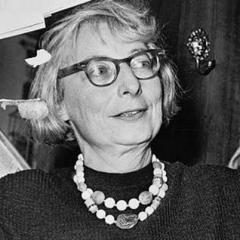
Jane Jacobs, an American journalist and urban theorist, was born on May 4, 1916, and passed away on April 25, 2006. She is renowned for her profound insights into urban life and her unique perspectives on urban planning. Her book, 'The Death and Life of Great American Cities,' had a revolutionary impact on modern urban planning. more
You May Also Like
“A lifetime can be spent in a Magellanic voyage around the trunk of a single tree.”
“One does not seek love,' she told him, 'it should find you all on it's own”
“Sometimes life is not fair, and sometimes it is not your fault.”
“How ironic it is to have your past-self staring at you”