Quotessence
Home / Quotes / Quote by Iris Murdoch

Quote by Iris Murdoch

“How rewarding it would be" to “write the whole of one’s life thus bit by bit as a novel. . . . The pleasant parts would be doubly pleasant, the funny parts funnier, and sin and grief would be softened by a light of philosophic consolation.”

Quote by Iris Murdoch

Work

The Sea, The Sea

This novel is a rich tapestry of interconnected narratives that delve into the complexities of human experience. Set in the early 20th century, it follows the lives of a group of individuals connected to a theater company. The story is characterized by its exploration of themes such as memory, art, and the fleeting nature of time. The author employs a unique narrative structure that intertwines the lives of these characters, creating a deeply moving and introspective work. more

Author

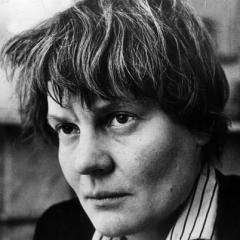
Iris Murdoch
Iris Murdoch

Iris Murdoch was an Irish-Canadian philosopher and author, born on July 15, 1919, in Dublin, Ireland, and passed away on February 8, 1999. She is celebrated for her philosophical novels that intertwine moral and ethical dilemmas with complex narratives. Murdoch's work has left a lasting impact on the literary world, particularly in the latter half of the 20th century. more

You May Also Like

“I was beginning to have an old familiar sensation which, oddly enough, I tended to forget in the interim, a feeling of disappointment and frustrated helplessness, as if I had looked forward to talking to James and had then been deliberately excluded from some kind of treat; as if something significant which I wanted to tell him had been, inside my very soul, shrivelled, trivialized by a casual laser beam of his intelligence. James’s mode of thought, his level of abstraction, was entirely unlike mine and he seemed to be sometimes almost frivolously intent upon exhibiting the impossibility of any communication between us. But of course really there was no intent, and indeed no treat, and in many ways my cousin could be seen as a bore, as an eccentric pedant with a kind of world-weariness which was simply tedious. He too after all had had his disappointments and about the most important of these I would doubtless never know. I suppose what I wanted was simply some ordinary amicable converse with James, which never happened, and which I was perhaps wrong in thinking that I could even imagine.”

“She gave me her limp hand. It felt damp and unresponsive and small and I could not continue the gesture into an embrace. She withdrew her hand and began to fiddle in her handbag. She brought out a fragment of the mirror which had been broken by Rosina’s kick, then a small white handkerchief. As soon as she had the handkerchief in her hand she began very quietly to cry. I felt so touched and sad, and yet so oddly proudly detached and somehow sentimental, as I seemed to see in a second, all rolled up into a ball and all vanishing, some life that I might have had with Lizzie, my Cherubino, my Ariel, my Puck, my son: some life we might have had together if I had been different, and she had been different. Now it was gone, whatever happened next, and the world was changed.”

“Even if readers claim that they 'take it all with a grain of salt', they do not really. They yearn to believe, and they believe, because believing is easier than disbelieving, and because anything which is written down is likely to be 'true in a way'. I trust this passing reflection will not lead anyone to doubt the truth of any part of this story! When I come to describe my life with Clement Makin credulity will be strained but will I hope not fail!”

“The trouble with you, Charles, is that basically you despise women, whereas I, in spite of some appearances to the contrary, do not." "I don't despise women. I was in love with all Shakespeare's heroines before I was twelve." "But they don't exist, dear man, that's the point. They live in the never-never land of art, all tricked out in Shakespeare's wit and wisdom, and mock us from there, filling us with false hopes and empty dreams. The real thing is spite and lies and arguments about money.”