Quotessence
Home / Quotes / Quote by Bertrand Russell

Quote by Bertrand Russell

“It seems to me now that mathematics is capable of an artistic excellence as great as that of any music, perhaps greater; not because the pleasure it gives (although very pure) is comparable, either in intensity or in the number of people who feel it, to that of music, but because it gives in absolute perfection that combination, characteristic of great art, of godlike freedom, with the sense of inevitable destiny; because, in fact, it constructs an ideal world where everything is perfect and yet true.”

Quote by Bertrand Russell

Work

The Autobiography of Bertrand Russell

This book offers an in-depth look into the personal and intellectual journey of Bertrand Russell, covering his early life, academic pursuits, and contributions to philosophy, mathematics, and social issues. more

Author
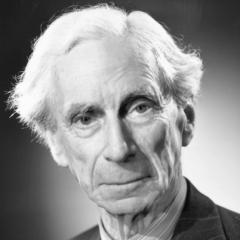
Bertrand Russell
Bertrand Russell

Bertrand Russell was a British philosopher, mathematician, and logician born on May 18, 1872, and died on February 2, 1970. He is known for his contributions to logic and mathematics, particularly in the fields of mathematical logic and philosophical analysis. His works spanned a wide range of subjects, including ethics, political philosophy, history, and literary criticism. more

You May Also Like

“The goal of a definition is to introduce a mathematical object. The goal of a theorem is to state some of its properties, or interrelations between various objects. The goal of a proof is to make such a statement convincing by presenting a reasoning subdivided into small steps each of which is justified as an "elementary" convincing argument.”

“Outside observers often assume that the more complicted a piece of mathematics is, the more mathematicians admire it. Nothing could be further from the truth. Mathematicians admire elegance and simplicity above all else, and the ultimate goal in solving a problem is to find the method that does the job in the most efficient manner. Though the major accolades are given to the individual who solves a particular problem first, credit (and gratitude) always goes to those who subsequently find a simpler solution.”

“Did chemistry theorems exist? No: therefore you had to go further, not be satisfied with the quia, go back to the origins, to mathematics and physics. The origins of chemistry were ignoble, or at least equivocal: the dens of the alchemists, their abominable hodgepodge of ideas and language, their confessed interest in gold, their Levantine swindles typical of charlatans and magicians; instead, at the origin of physics lay the strenuous clarity of the West-Archimedes and Euclid.”

“In my own professional work I have touched on a variety of different fields. I've done work in mathematical linguistics, for example, without any professional credentials in mathematics; in this subject I am completely self-taught, and not very well taught.”

“But on the other hand, in discussion and debate concerning social issues or American foreign policy, Vietnam or the Middle East, for example, the issue is constantly raised, often with considerable venom. I've repeatedly been challenged on grounds of credentials, or asked, what special training do you have that entitles you to speak of these matters. The assumption is that people like me, who are outsiders from a professional viewpoint, are not entitled to speak on such things.”

“Compare mathematics and the political sciences - it's quite striking. In mathematics, in physics, people are concerned with what you say, not with your certification. But in order to speak about social reality, you must have the proper credentials, particularly if you depart from the accepted framework of thinking. Generally speaking, it seems fair to say that the richer the intellectual substance of a field, the less there is a concern for credentials, and the greater is the concern for content.”