Quotessence
Home / Quotes / Quote by Bertrand Russell

Quote by Bertrand Russell

“In his youth, Wordsworth sympathized with the French Revolution, went to France, wrote good poetry and had a natural daughter. At this period, he was a bad man. Then he became good, abandoned his daughter, adopted correct principles and wrote bad poetry.”

Quote by Bertrand Russell

Work

Sceptical Essays

This book delves into the principles of skepticism, examining various arguments and perspectives on critical thinking and rational inquiry. more

Author

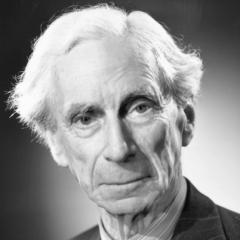
Bertrand Russell
Bertrand Russell

Bertrand Russell was a British philosopher, mathematician, and logician born on May 18, 1872, and died on February 2, 1970. He is known for his contributions to logic and mathematics, particularly in the fields of mathematical logic and philosophical analysis. His works spanned a wide range of subjects, including ethics, political philosophy, history, and literary criticism. more

You May Also Like

“In astronomy, the law of gravitation is plainly better worth knowing than the position of a particular planet on a particular night, or even on every night throughout a year. There are in the law a splendour and simplicity and sense of mastery which illuminate a mass of otherwise uninteresting details. But in history the matter is far otherwise. Historical facts, many of them, have an intrinsic value, a profound interest on their own account, which makes them worthy of study, quite apart from any possibility of linking them together by means of causal laws.”

“The process of philosophizing, to my mind, consists mainly in passing from those obvious, vague, ambiguous things, that we feel quite sure of, to something precise, clear, definite, which by reflection and analysis we find is involved in the vague thing that we start from, and is, so to speak, the real truth of which that vague thing is a sort of shadow.”

“The question of "unreality"is a very important one. Misled by grammar, the great majority of those logicians who have dealt with this question have dealt with it on mistaken lines. They have regarded grammatical form as a surer guide in analysis than, in fact, it is. And they have not known what differences in grammatical form are important.”

“Man is a rational animal—so at least I have been told. … Aristotle, so far as I know, was the first man to proclaim explicitly that man is a rational animal. His reason for this view was … that some people can do sums. … It is in virtue of the intellect that man is a rational animal. The intellect is shown in various ways, but most emphatically by mastery of arithmetic. The Greek system of numerals was very bad, so that the multiplication table was quite difficult, and complicated calculations could only be made by very clever people.”