Quotessence
Home / Quotes / Quote by Margaret Thatcher

Quote by Margaret Thatcher

“Yet the basic fact remains: every regulation represents a restriction of liberty, every regulation has a cost. That is why, like marriage (in the Prayer Book's words), regulation should not "be enterprised, nor taken in hand, unadvisedly, lightly, or wantonly"”

Quote by Margaret Thatcher

Author
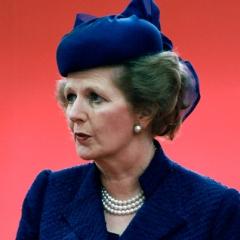
Margaret Thatcher
Margaret Thatcher

Margaret Thatcher, born on October 13, 1925, was a former Prime Minister of the United Kingdom. Known for her strong political stance and reformist policies, she is one of the most influential political figures of the 20th century. Thatcher served as Prime Minister from 1979 to 1990, implementing a series of economic and social reforms that had a profound impact on the UK and the global political and economic landscape. more

You May Also Like

“Freedom is messy. In free societies, people will fall through the cracks - drink too much, eat too much, buy unaffordable homes, fail to make prudent provision for health care, and much else. But the price of being relieved of all those tiresome choices by a benign paternal government is far too high. Big Government is the small option: it's the guarantee of smaller freedom, smaller homes, smaller cars, smaller opportunities, smaller lives.”

“And when it comes to developing the high standards we need, it's time to stop working against our teachers and start working with them. Teachers don't go in to education to get rich. They don't go in to education because they don't believe in their children. They want their children to succeed, but we've got to give them the tools. Invest in early childhood education. Invest in our teachers and our children will succeed.”

“Thousands of years ago, weren't we capable of building enormous structures like the pyramids? Weren't we capable of worshiping gods, weaving, making fire, finding lovers and wives, sending written messages? Of course we were. But although we've succeeded in replacing slaves with wage slaves, all the advances we've made have been in the field of science. Human beings are still asking the same questions as their ancestors. In short, they haven't evolved at all.”

“This is how one pictures the angel of history. His face is turned toward the past. Where we perceived a chain of events, he sees one single catastrophe which keeps piling wreckage and hurls it in front of his feet. The angel would like to stay, awaken the dead, and make whole what has been smashed. But a storm is blowing from Paradise; it has got caught in his wings with such violence that the angel can no longer close them. This storm irresistably propels him into the future to which his back is turned, while the pile of debris before him grows skyward. The storm is what we call progress.”

“What would it mean if there were a theory that explained everything? And just what does "everything" actually mean, anyway? Would this new theory in physics explain, say the meaning of human poetry? Or how economics work? Or the stages of psychosexual development? Can this new physics explain the currents of ecosystems, or the dynamics of history, or why human wars are so terribly common?”

“We're not going to waste our valuable space or your precious energy by giving equal time to stories of tragedy, failure, and tumult. They get far more that their fair share of attention everywhere else. Future historians might even conclude that our age suffered from a collective obsessive-compulsive disorder: the pathological need to repetitively seek out reasons for how bad life is.”

“Naturally, every age thinks that all ages before it were prejudiced, and today we think this more than ever and are just as wrong as all previous ages that thought so. How often have we not seen the truth condemned! It is sad but unfortunately true that man learns nothing from history.”