Quotessence
Home / Quotes / Quote by Xenophanes

Quote by Xenophanes

“...for our wisdom is better than the strength of men or of horses. ... nor is it right to prefer strength to excellent wisdom. For if there should be in the city [any athlete whose skill] is honoured more than strength ... the city would not on that account be any better governed.”

Quote by Xenophanes

Author
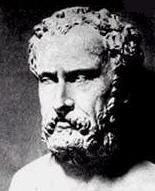
Xenophanes
Xenophanes

Xenophanes, a Greek philosopher born around 570 BC in the Greek colony of Colophon and died around 476 BC, is considered one of the pioneers of Western philosophy. He is known for his profound thoughts on nature and the universe. Xenophanes emphasized the unity and infinity of the universe and proposed unique views on the nature of gods and humans. more

You May Also Like

“[When questioned on his longevity] First of all, I selected my ancestors very wisely. ... They were long-lived, healthy people. Then, as a chemist, I know how to eat, how to exercise, keep my blood circulating. ... I don't worry. I don't get angry at people. I don't worry about things I can't help. I do what I can to make the world a better place to live, but I don't complain if things aren't right. As a scientist I take the world as I find it.”

“By science calmed, over the peaceful soul, Bright with eternal Wisdom's lucid ray, Peace, meek of eye, extends her soft control, And drives the puny Passions far away.”

“It is odd to think that there is a word for something which, strictly speaking, does not exist, namely, "rest." We distinguish between living and dead matter; between moving bodies and bodies at rest. This is a primitive point of view. What seems dead, a stone or the proverbial "door-nail," say, is actually forever in motion. We have merely become accustomed to judge by outward appearances; by the deceptive impressions we get through our senses.”

“The only distinct meaning of the word "natural" is stated, fixed, or settled; since what is natural as much requires and presupposes an intelligent agent to render it so, i.e. to effect it continually or at stated times, as what is supernatural or miraculous does to effect it for once.”

“This new force, which was unknown until now, is common to organic and inorganic nature. I do not believe that this is a force entirely independent of the electrochemical affinities of matter; I believe, on the contrary, that it is only a new manifestation, but since we cannot see their connection and mutual dependence, it will be easier to designate it by a separate name. I will call this force catalytic force. Similarly, I will call the decomposition of bodies by this force catalysis, as one designates the decomposition of bodies by chemical affinity analysis.”