Quotessence
Home / Quotes / Quote by Thomas Jefferson

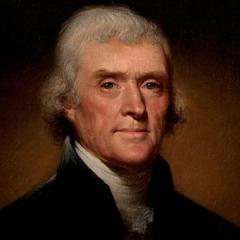
Quote by Thomas Jefferson

“The fumes of the most disordered imaginations were recorded in their religious code, as special communications of the Deity; and as it could not but happen that, in the course of ages, events would now and then turn up to which some of these vague rhapsodies might be accommodated by the aid of allegories, figures, types, and other tricks upon words, they have not only preserved their credit with the Jews of all subsequent times, but are the foundation of much of the religions of those who have schismatised from them.”

Quote by Thomas Jefferson

Book:Letters

Work

Letters

A compilation of personal and professional exchanges that delve into the complexities of human connection and introspection. more

Author

Thomas Jefferson
Thomas Jefferson

Thomas Jefferson was the third President of the United States, a distinguished politician, philosopher, architect, and scientist. He was born on April 13, 1743, and died on July 4, 1826. Jefferson advocated for democracy and freedom in politics and was one of the main authors of the Declaration of Independence. His political ideas had a profound impact on the founding and development of the United States. more

You May Also Like

“I believe the American people are more concerned with a man's views and abilities than with the church to which he belongs. I believe the founding fathers meant it when they provided in Article VI of the Constitution that there should be no religious test for public office. And I believe that the American people mean to adhere to those principles today.”

“When men have appreciated the countless differences which the exercise of that judgment must necessarily produce, when they have estimated the intrinsic fallibility of their reason, and the degree in which it is distorted by the will, when, above all, they have acquired that love of truth which a constant appeal to private judgment at last produces, they will never dream that guilt can be associated with an honest conclusion, or that one class of arguments should be stifled by authority.”

“Faith always presented to the mind the idea of an abnormal intellectual condition, of the subversion or suspension of the critical faculties. It sometimes comprised more than this, but it always included this. It was the opposite of doubt and of the spirit of doubt. What irreverent men called credulity, reverent men called faith; and although one word was more respectful than the other, yet the two words were with most men strictly synonymous.”

“Nothing, indeed, could be more unlike the tone of the [Patristic] Fathers, than the cold, passionless, and prudential theology of the eighteenth century; a theology which regarded Christianity as an admirable auxiliary to the police force, and a principle of decorum and of cohesion in society, but which carefully banished from it all enthusiasm, veiled or attenuated all its mysteries, and virtually reduced it to an authoritative system of moral philosophy.”