Quotessence
Home / Quotes / Quote by John F. Kennedy

Quote by John F. Kennedy

“I am flatly opposed to appointment of an ambassador to the Vatican. Whatever advantages it might have in Rome - and I'm not convinced of these - they would be more than offset by the divisive effect at home.”

Quote by John F. Kennedy

Author
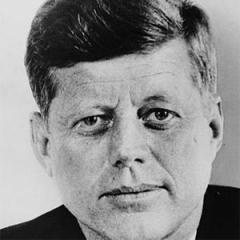
John F. Kennedy
John F. Kennedy

John F. Kennedy was the 35th President of the United States, serving from 1961 to 1963. His presidency was marked by the Civil Rights Act, the New Frontier policy, and the intense Cold War confrontation with the Soviet Union. Kennedy was known for his youthful charm and charisma, but his assassination during his term shocked the world. more

You May Also Like

“I believe the American people are more concerned with a man's views and abilities than with the church to which he belongs. I believe the founding fathers meant it when they provided in Article VI of the Constitution that there should be no religious test for public office. And I believe that the American people mean to adhere to those principles today.”

“When men have appreciated the countless differences which the exercise of that judgment must necessarily produce, when they have estimated the intrinsic fallibility of their reason, and the degree in which it is distorted by the will, when, above all, they have acquired that love of truth which a constant appeal to private judgment at last produces, they will never dream that guilt can be associated with an honest conclusion, or that one class of arguments should be stifled by authority.”

“Faith always presented to the mind the idea of an abnormal intellectual condition, of the subversion or suspension of the critical faculties. It sometimes comprised more than this, but it always included this. It was the opposite of doubt and of the spirit of doubt. What irreverent men called credulity, reverent men called faith; and although one word was more respectful than the other, yet the two words were with most men strictly synonymous.”

“Nothing, indeed, could be more unlike the tone of the [Patristic] Fathers, than the cold, passionless, and prudential theology of the eighteenth century; a theology which regarded Christianity as an admirable auxiliary to the police force, and a principle of decorum and of cohesion in society, but which carefully banished from it all enthusiasm, veiled or attenuated all its mysteries, and virtually reduced it to an authoritative system of moral philosophy.”

“Making every allowance for the errors of the most extreme fallibility, the history of Catholicism would on this hypothesis represent an amount of imposture probably unequaled in the annals of the human race.”

“[Middleton] contended that the religious leaders of the fourth century had admitted, eulogised, and habitually acted upon principles that were diametrically opposed, not simply to the aspirations of a transcendent sanctity, but to the dictates of the most common honesty. He showed that they had applauded falsehood, that they had practised the most wholesale forgery, that they had habitually and grossly falsified history, that they had adopted to the fullest extent the system of pious frauds, and that they continually employed them to stimulate the devotion of the people.”