Quotessence
Home / Quotes / Quote by Junot Diaz

Quote by Junot Diaz

“I always wanted to read. I always thought I was going to be a historian. I would go to school and study history and then end up in law school, once, I ran out of loot trying to be a history high school teacher. But my dream was always to place myself in a situation where I was always surrounded by books.”

Quote by Junot Diaz

Author
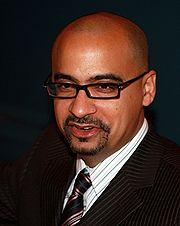
Junot Diaz
Junot Diaz

Junot Díaz is a renowned American writer known for his magical realism style and profound social commentary. His works often focus on the lives of Dominican and Puerto Rican immigrants in the United States, particularly the roles of women in these communities. Díaz's debut novel, 'Drown,' won the National Book Award, and his second novel, 'The Brief Wondrous Life of Oscar Wao,' earned the Pulitzer Prize for Fiction. more

You May Also Like

“The classic one for me is one of my favorite images - left-versus-right political-spectrum image. I was trying to visualize the concepts on the political spectrum. I'm left-leaning, and I discovered as I was doing it that I had an impulse to make the left-hand side appear better than the right-hand side. That was manifesting in the way I was choosing certain words, framing certain ideas. I shared it with a few people, and they all said, "Oh my God, this is really biased." I hadn't seen it at all.”

“I've been working on a graphic about carbon emissions. It's an incredibly simple graphic - a bunch of blocks and a table below it - but it's taken me three weeks to design. For some reason it just wasn't working. Then finally I realized there was a number present, which I was rendering in each version, that wasn't necessary for the understanding of the piece. This figure was getting in the way and distracting from the main flow of the narrative. As soon as I pulled that graphic out of the design, it sprang into focus. Suddenly it worked.”

“Simplification seems to be the removal of objects for the goal of making a graphic as clean and uncluttered as possible. Whereas, with optimization, it feels like there's more intelligence in that. It maintains the usability, but tries to distill something down to its essence. But with some data-sets you have to be careful because, as with linear, print journalism, it's easy to shave off facts that don't quite fit the flow.”