Quotessence
Home / Quotes / Quote by Marc Benioff

Quote by Marc Benioff

“I had one goal. I wanted people to really learn the tools that could change, because I taught finance for years, I network with people in their 20s, obviously, and all ages I've worked with. But I wanted to just take that to another level, and I also, quite frankly, was just angry. I was angry about the level of abuse I saw in 2008 that happened to people. I knew what happened, I had made a fortune during that time because when things melt down - and they're going to again; life is cyclical - it's one of the greatest opportunities in your life.”

Quote by Marc Benioff

Author
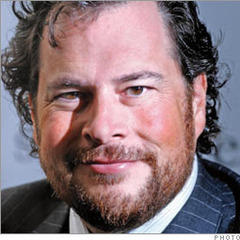
Marc Benioff
Marc Benioff

Marc Benioff is an American entrepreneur and author, renowned for his innovations in the Software as a Service (SaaS) industry. Born on September 25, 1964, he is the co-founder and CEO of Salesforce.com. Benioff is respected for his promotion of cloud computing and transformative impact on the enterprise software industry. more

You May Also Like

“I know Donald Trump quite well. We've never shared values, he and I. But I respected his ability to turn it around. So I respect somebody who can turn things around and be successful. I think the president's communication style is the most difficult thing because he actually does care, people who know him know he cares. But his style of communication, his combative approach, the elements of ego that are obviously there in all of us but seem to be more easy to see in the president sometimes than other people, get in the way of his capacity to lead, unfortunately.”

“I've worked with a variety of presidents over the years on both sides of the aisle and congressmen and senators, so I'm not into trying to demonize anybody. It used to be that people would fight like hell on the floor of the house and they'd go have a beer together. Now it's like you're radioactive if you talk to the other side, which keeps us from getting anything done. I'm an independent personally, and I vote for who I believe will make the biggest difference.”

“Business requires an unbelievable level of resilience inside you, the chokehold on the growth of your business is always the leader, it's always your psychology and your skills - 80% psychology, 20% skills. If you don't have the marketing skills, if you don't have the financial-intelligence skills, if you don't have the recruiting skills, it's really hard for you to lead somebody else if you don't have fundamentally those skills. And so my life is about teaching those skills and helping people change the psychology so that they live out of what's possible, instead of out of their fear.”

“There's an all-enveloping destructiveness in Donald Trump's character and in his psychological tendencies. But I've focused on what professionally I call solipsistic reality. Solipsistic reality means that the only reality he's capable of embracing has to do with his own self and the perception by and protection of his own self. And for a president to be so bound in this isolated solipsistic reality could not be more dangerous for the country and for the world. He's not psychotic, but I think ultimately this solipsistic reality will be the source of his removal from the presidency.”

“Donald Trump doesn't have clear contact with reality, though I'm not sure it qualifies as a bona fide delusion. He needs things to be a certain way even though they aren't, and that's one reason he lies. There can also be a conscious manipulative element to it. When he put forward, and politically thrived on, the falsehood of President Obama's birth in Kenya, outside the United States, he was manipulating that lie as well as undoubtedly believing it in part, at least in a segment of his personality.”

“While Donald Trump doesn't have any systematic ideology, he does have a narrative, and in that narrative, America was once a great country, it's been weakened by poor leadership, and only he can make it great again by taking over. And that's an image of himself as a strongman, a dictator. It isn't the clear ideology of being a fascist or some other clear-cut ideological figure. Rather, it's a narrative of himself as being unique and all-powerful. He believes it, though I'm sure he's got doubts about it.”

“Donald Trump gives the impression that he would like to govern by decree. He has that impulse in him and he wants to be a savior, so he says, in his famous phrase, "Only I can fix it!" That's a strange and weird statement for anybody to make, but it's central to Trump's sense of self and self-presentation. And I think that has a lot to do with his identification with dictators. No matter how many they kill and no matter what else they do, they have this capacity to rule by decree without any interference by legislators or courts.”

“In early psychoanalytic thought, narcissism was - and still, of course, is - self-love. The early psychoanalysts used to talk of libido directed at the self. That now feels a little quaint, that kind of language. But it does include the most fierce and self-displaying form of one's individual self. And in this way, it can be dangerous. When you look at Donald Trump, you can really see someone who's destructive to any form of life enhancement in virtually every area. And if that's what Fromm means by malignant narcissism, then it definitely applies.”

“For anyone with the traits - of feeling himself victimized, of seeking to be the strongman who resolves everything, yet sees truth only through his own self and negates all other truth outside of it - is bound to become more malignant when he has power. Power then breeds an intensification of all this because the power can never be absolute power - to some extent it's stymied - but the isolation while in power becomes even more dangerous. Think of it as a vicious circle. The power intensifies these tendencies and the tendencies become more dangerous because of the power.”