Quotessence
Home / Quotes / Quote by William Whewell

Quote by William Whewell

“...the question undoubtedly is, or soon will be, not whether or no we shall employ notation in chemistry, but whether we shall use a bad and incongruous, or a consistent and regular notation.”

Quote by William Whewell

Author
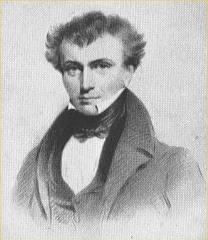
William Whewell
William Whewell

William Whewell was a polymath from England, born on May 24, 1794, and died on March 6, 1866. He made significant contributions to the fields of scientific philosophy, the history of science, logic, mathematics, and astronomy. more

You May Also Like

“Chemistry is yet, indeed, a mere embryon. Its principles are contested; experiments seem contradictory; their subjects are so minute as to escape our senses; and their result too fallacious to satisfy the mind. It is probably an age too soon to propose the establishment of a system.”

“Chlorine is a deadly poison gas employed on European battlefields in World War I. Sodium is a corrosive metal which burns upon contact with water. Together they make a placid and unpoisonous material, table salt. Why each of these substances has the properties it does is a subject called chemistry.”

“Dr. Johnson ... sometimes employed himself in chymistry, sometimes in watering and pruning a vine, and sometimes in small experiments, at which those who may smile, should recollect that there are moments which admit of being soothed only by trifles.”

“Even mistaken hypotheses and theories are of use in leading to discoveries. This remark is true in all the sciences. The alchemists founded chemistry by pursuing chimerical problems and theories which are false. In physical science, which is more advanced than biology, we might still cite men of science who make great discoveries by relying on false theories.”

“For chemistry is no science form'd à priori; 'tis no production of the human mind, framed by reasoning and deduction: it took its rise from a number of experiments casually made, without any expectation of what follow'd; and was only reduced into an art or system, by collecting and comparing the effects of such unpremeditated experiments, and observing the uniform tendency thereof. So far, then, as a number of experimenters agree to establish any undoubted truth; so far they may be consider'd as constituting the theory of chemistry.”

“For example, there are numbers of chemists who occupy themselves exclusively with the study of dyestuffs. They discover facts that are useful to scientific chemistry; but they do not rank as genuine scientific men. The genuine scientific chemist cares just as much to learn about erbium-the extreme rarity of which renders it commercially unimportant-as he does about iron. He is more eager to learn about erbium if the knowledge of it would do more to complete his conception of the Periodic Law, which expresses the mutual relations of the elements.”

“I think chemistry is being frittered away by the hairsplitting of the organic chemists; we have new compounds discovered, which scarcely differ from the known ones and when discovered are valueless-very illustrations perhaps of their refinements in analysis, but very little aiding the progress of true science.”