Quotessence
Home / Quotes / Quote by Pope Pius X

Quote by Pope Pius X

“But since the Modernists (as they are commonly and rightly called) employ a very clever artifice, namely, to present their doctrines without order and systematic arrangement into one whole, scattered and disjointed one from another, so as to appear to be in doubt and uncertainty, while they are in reality firm and steadfast, it will be of advantage, Venerable Brethren, to bring their teachings together here into one group, and to point out the connexion between them, and thus to pass to an examination of the sources of the errors, and to prescribe remedies for averting the evil.”

Quote by Pope Pius X

Author
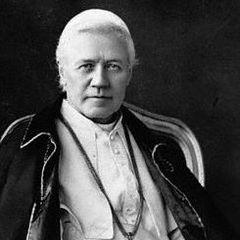
Pope Pius X
Pope Pius X

Pope Pius X, born Giuseppe Sarto, was an Italian Catholic Pope who served from 1903 to 1914. He was the first Italian to be elected Pope and the last to die within the Vatican City. During his papacy, he was known for his opposition to modernism and reform, emphasizing traditional doctrine and the authority of the Church. more

You May Also Like

“Truly we are passing through disastrous times, when we may well make our own the lamentation of the Prophet: "There is no truth, and there is no mercy, and there is no knowledge of God in the land" (Hosea 4:1). Yet in the midst of this tide of evil, the Virgin Most Merciful rises before our eyes like a rainbow, as the arbiter of peace between God and man.”

“From that point on, the extraordinary system of spies and informers which has played an important part in the political work of the French state into our own time took shape. (Sartine, who became lieutenant general de police in 1759, is supposed to have said to Louis XV, "Sire, when three people are chatting in the street one of them is surely my man.") Eighteenth-century police manuals like those of Colquhoun in England or Lemaire in France are no less than general treatises on the government's full repertoire of domestic regulation, coercion, and surveillance.”

“When the press writes scare stories about the global labor supply draining jobs from rich to poor places, the story is usually presented as a "race to the bottom" simply in terms of wages. Capitalism supposedly looks for labor wherever labor is cheapest. This story is half wrong. A kind of cultural selection is also at work, so that jobs leave high-wage countries like the United States and Germany, but migrate to low-wage economies with skilled, sometimes overqualified workers.”