Quotessence
Home / Quotes / Quote by Wesley Clark

Quote by Wesley Clark

“Actually when I was wounded and recovering in Japan. I went to church there and I remember on the air base where their hospital was, I remember coming out of that church and feeling like I had been - at that point I just felt very, very close to God and that I'd done the right thing with my life. And I knew I wasn't going back to Vietnam. I just knew I wasn't going back.”

Quote by Wesley Clark

Author
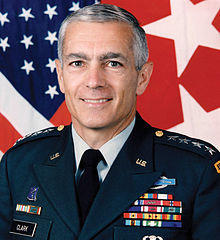
Wesley Clark
Wesley Clark

Wesley Clark is an American political figure born on December 23, 1944. He served in a significant role in the United States military and has had a wide-reaching influence in politics. more

You May Also Like

“One night I walked out of the church when the priest said that we should never have fought the Revolutionary war and every war was bad. It was 4th of July. It was an outrageously political statement. I just never felt right when people in the church would take these overtly political positions especially when I felt like I was a good Christian, I was serving my country, and I just didn't feel like I deserved to be lambasted by the priest on the 4th of July.”

“My mom didn't run for mayor until she was 65 years old - it was like a second and third career.... The way I've always thought about it is that I don't believe you run for office because you want a job. I believe if you run for office, it's because you have a vision for change. And if I ever came to that point, that's what would lead [me to run]. And right now I'm happily in a position where I believe I can work to deliver impact and work for change.”

“I had to sign the paper to shut down the government. It's terrible.... [But] what the shutdown showed many, many people is the importance of the role of government. And as frustrated [as people get with] Washington, there are so many things [the government does] that are so important to people's lives every day. The panda cam, paying small businesses their loans - these are all things that shut down.”

“I have been fortunate to work in places where people have a passion for their work. At HHS the passion sort of exceeds passion - it's a vocation.... I obviously knew that there were certainly some challenges that I would be taking on both with the work and the politics. [But] I probably did not have the right expectation level with regard to the number and volume of crises that would occur.”

“Certainly there was the Affordable Care Act part, then unaccompanied children [there has been a surge of children entering the country illegally and without parents, particularly in Texas], and things like, we find smallpox in an NIH lab, after 50 years? Why didn't you find it, like, five weeks ago or three years ago? There was thing after thing. But the big ones were [dealing with] the Ebola [outbreak], the unaccompanied children. [It was] perhaps a bigger challenge than I had calculated on my yellow pad as I was thinking about this role.”

“First of all, women inherently, I think, are quite capable of having lots of balls in the air. And so, like, it's all those skills you use; you analyze the problem, figure out your tools, and then go at it piece by piece.... It's like what you have to do in the morning to get your kids out the door [if you're a parent]. The skills are, I believe, the same. The patience issues are the same.”

“We know there are states, like Alaska, where there are not a lot of providers. How do we work on issues like that? How do we work on making sure that the small-business part of this works better?... And if people have [alternate] plans, let's compare them and see. Access, affordability, and quality - that's what this is about. [But] "repeal" is a symbol of something that I don't think is connected to the substance of what's happening. Do you want to take away care from people who have preexisting conditions? [Repeal] takes you backward.”