Quotessence
Home / Quotes / Quote by Alexander Hamilton

Quote by Alexander Hamilton

Work

The Vision of Hamilton: Hamilton's 4 Reports and LaRouche's 4 Laws

The book delves into the historical and philosophical underpinnings of these economic and political frameworks, analyzing their impact on modern economic policies and political thought. more

Author
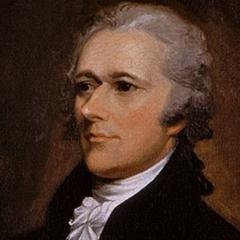
Alexander Hamilton
Alexander Hamilton

Alexander Hamilton was a Founding Father of the United States, born on January 11, 1757, and died on July 12, 1804. He played a crucial role in the American Revolutionary War and was instrumental in the drafting of the U.S. Constitution. As the first Secretary of the Treasury, Hamilton promoted fiscal stability and economic growth, establishing the First Bank of the United States and proposing solutions for federal debt. His ideas and policies had a profound impact on the early political and economic development of the United States. more

You May Also Like

“The proposed Constitution, so far from implying an abolition of the State governments, makes them constituent parts of the national sovereignty, by allowing them a direct representation in the Senate, and leaves in their possession certain exclusive and very important portions of sovereign power. This fully corresponds, in every rational import of the terms, with the idea of a federal government.”

“Each State, in ratifying the Constitution, is considered as a sovereign body, independent of all others, and only to be bound by its own voluntary act. In this relation, then, the new Constitution will, if established, be a FEDERAL, and not a NATIONAL constitution.”

“But ambitious encroachments of the federal government, on the authority of the State governments, would not excite the opposition of a single State, or of a few States only. They would be signals of general alarm . . . But what degree of madness could ever drive the federal government to such an extremity.”

“I wish not to be regarded as an advocate for the particular organizations of the several state governments . . . they carry strong marks of the haste, and still stronger marks of the inexperience, under which they were framed.”

“The public affairs of the union are spread throughout a very extensive region, and are extremely diversified by the local affairs connected with them, and can with difficulty be learnt in any other place, than in the central councils, to which a knowledge of them will be brought by the representatives of every part of the empire. Yet some knowledge of the affairs, and even of the laws of all the states, ought to be possessed by the members from each of the states.”

“The appointment of senators by the state legislatures . . . is recommended by the double advantage of favoring a select appointment, and of giving to the state governments such an agency in the formation of the federal government, as must secure the authority of the former.”

“It is superfluous to try by the standards of theory, a part of the constitution which is allowed on all hands to be the result not of theory, but "of a spirit of amity, and that mutual deference and concession which the peculiarity of our political situation rendered indispensable" . . . the equal vote allowed to each state, is at once a constitutional recognition of the portion of sovereignty remaining in the individual states, and an instrument for preserving that residuary sovereignty.”