Quotessence
Home / Quotes / Quote by James Madison

Quote by James Madison

“It is superfluous to try by the standards of theory, a part of the constitution which is allowed on all hands to be the result not of theory, but "of a spirit of amity, and that mutual deference and concession which the peculiarity of our political situation rendered indispensable" . . . the equal vote allowed to each state, is at once a constitutional recognition of the portion of sovereignty remaining in the individual states, and an instrument for preserving that residuary sovereignty.”

Quote by James Madison

Author
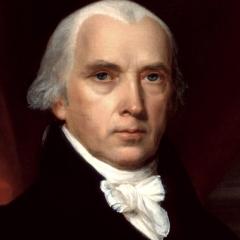
James Madison
James Madison

James Madison, the 4th President of the United States, was born on March 16, 1751, and died on June 28, 1836. He was a key figure in drafting the U.S. Constitution and had a profound impact on the political system of the United States. more

You May Also Like

“Another advantage accruing from this ingredient in the constitution of a senate, is the additional impediment it must prove against improper acts of legislation. No law or resolution can now be passed without the concurrence first of a majority of the people, and then of a majority of the states.”

“That useful alterations will be suggested by experience, could not but be foreseen . . . . It moreover equally enables the general and state governments to originate the amendment of errors as they may be pointed out by the experience on one side or on the other.”

“I confess I am at a loss to discover what temptation the persons entrusted with the administration of the general government could ever feel to divest the States of the authorities of that description. The regulation of the mere domestic police of a State appears to me to hold out slender allurements to ambition.”

“The administration of private justice between the citizens of the same state, the supervision of agriculture and of other concerns of a similar nature, all those things in short which are proper to be provided for by local legislation, can never be desirable cares of a general jurisdiction . . . the attempt to exercise these powers would be as troublesome as it would be nugatory; and the possession of them, for that reason, would contribute nothing to the dignity, to the importance, or to the splendour of the national government.”

“The variety of more minute interests, which will necessarily fall under the superintendence of the local administrations . . . cannot be particularized without involving a detail too tedious and uninteresting to compensate for the instruction it might afford.”

“It may be laid down as a general rule, that their confidence in and obedience to a government, will be commonly proportioned to the goodness or badness of its administration . . . . Various reasons have been suggested in the course of these papers, to induce a probability that the general government will be better administered than the particular governments.”

“It will be well to advert to the proportion between the objects that will require a federal provision in respect to revenue; and those which will require a state provision. We shall discover that the former are altogether unlimited; and that the latter are circumscribed within very moderate bounds.”

“Nothing can be more evident, than that an exclusive power of regulating elections for the National Government, in the hands of the State Legislatures, would leave the existence of the Union entirely at their mercy . . . . It is to little purpose to say that a neglect or omission of this kind [not letting the feds have elections], would be unlikely to take place. The constitutional possibility of the thing, without an equivalent for the risk, is an unanswerable objection.”