Quotessence
Home / Quotes / Quote by Alexander Hamilton

Quote by Alexander Hamilton

“I confess I am at a loss to discover what temptation the persons entrusted with the administration of the general government could ever feel to divest the States of the authorities of that description. The regulation of the mere domestic police of a State appears to me to hold out slender allurements to ambition.”

Quote by Alexander Hamilton

Work

The Federalist, on the new constitution, written in 1788, with an appendix, containing the letters of Pacificus and Helvidius on the proclamation of neutrality of 1793, also the original articles of confederation and the constitution of the United States

This book is a collection of essays and documents that discuss and defend the proposed United States Constitution. It includes the original text of the Constitution, the Articles of Confederation, and appendices with letters exchanged between Pacificus and Helvidius regarding the 1793 proclamation of neutrality. The work is considered a cornerstone of American political thought. more

Author
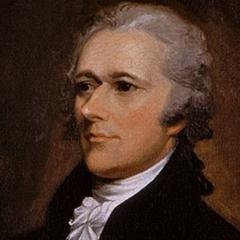
Alexander Hamilton
Alexander Hamilton

Alexander Hamilton was a Founding Father of the United States, born on January 11, 1757, and died on July 12, 1804. He played a crucial role in the American Revolutionary War and was instrumental in the drafting of the U.S. Constitution. As the first Secretary of the Treasury, Hamilton promoted fiscal stability and economic growth, establishing the First Bank of the United States and proposing solutions for federal debt. His ideas and policies had a profound impact on the early political and economic development of the United States. more

You May Also Like

“The administration of private justice between the citizens of the same state, the supervision of agriculture and of other concerns of a similar nature, all those things in short which are proper to be provided for by local legislation, can never be desirable cares of a general jurisdiction . . . the attempt to exercise these powers would be as troublesome as it would be nugatory; and the possession of them, for that reason, would contribute nothing to the dignity, to the importance, or to the splendour of the national government.”

“The variety of more minute interests, which will necessarily fall under the superintendence of the local administrations . . . cannot be particularized without involving a detail too tedious and uninteresting to compensate for the instruction it might afford.”

“It may be laid down as a general rule, that their confidence in and obedience to a government, will be commonly proportioned to the goodness or badness of its administration . . . . Various reasons have been suggested in the course of these papers, to induce a probability that the general government will be better administered than the particular governments.”

“It will be well to advert to the proportion between the objects that will require a federal provision in respect to revenue; and those which will require a state provision. We shall discover that the former are altogether unlimited; and that the latter are circumscribed within very moderate bounds.”

“Nothing can be more evident, than that an exclusive power of regulating elections for the National Government, in the hands of the State Legislatures, would leave the existence of the Union entirely at their mercy . . . . It is to little purpose to say that a neglect or omission of this kind [not letting the feds have elections], would be unlikely to take place. The constitutional possibility of the thing, without an equivalent for the risk, is an unanswerable objection.”

“The scheme of separate confederacies, which will always multiply the chances of ambition, will be a never failing bait to all such influential characters in the State administrations as are capable of preferring their own emolument and advancement to the public weal.”

“The power of the people pervading the proposed system, together with the strong confederation of the states, will form an adequate security against every danger that has been apprehended.”

“The proposed constitution, therefore, even when tested by the rules laid down by its antagonists, is, in strictness, neither a national nor a federal constitution; but a composition of both. In its foundation it is federal, not national; in the sources from which the ordinary powers of the government are drawn, it is partly federal, and partly national; in the operation of these powers, it is national, not federal; in the extent of them again, it is federal, not national; and finally, in the authoritative mode of introducing amendments, it is neither wholly federal, nor wholly national.”