Quotessence
Home / Quotes / Quote by Dalai Lama

Quote by Dalai Lama

“Human beings by nature want happiness and do not want suffering. With that feeling everyone tries to achieve happiness and tries to get rid of suffering, and everyone has the basic right to do this. In this way, all here are the same, whether rich or poor, educated or uneducated, Easterner or Westerner, believer or non-believer, and within believers whether Buddhist, Christian, Jewish, Muslim, and so on. Basically, from the viewpoint of real human value we are all the same.”

Quote by Dalai Lama

Author
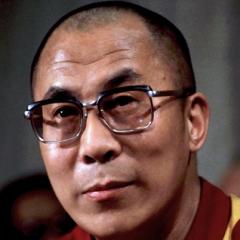
Dalai Lama
Dalai Lama

The Dalai Lama (born July 6, 1935) is the 14th Dalai Lama, a prominent religious leader of Tibetan Buddhism's Gelug school. Born as Tenzin Gyatso in Qinghai Province, China, he is recognized as an incarnation of Avalokiteshvara. He advocates non-violence, peace, and interfaith dialogue, and was awarded the Nobel Peace Prize in 1989. However, his political activities are viewed by the Chinese government as separatist, and he has lived in exile in India since 1959. His influence remains controversial, blending religious authority with political dissent. more

You May Also Like

“Self-discipline, although difficult, and not always easy while combating negative emotions, should be a defensive measure. At least we will be able to prevent the advent of negative conduct dominated by negative emotion. That is 'shila', or moral ethics. Once we develop this by familiarizing ourselves with it, along with mindfulness and conscientiousness, eventually that pattern and way of life will become a part of our own life.”

“Sometimes we feel that one individual's action is very insignificant. Then we think, of course, that effects should come from channeling or from a unifying movement. But the movement of the society, community or group of people means joining individuals. Society means a collection of individuals, so that initiative must come from individuals. Unless each individual develops a sense of responsibility, the whole community cannot move. So therefore, it is very essential that we should not feel that individual effort is meaningless- you should not feel that way. We should make an effort.”

“An affectionate disposition not only makes the mind more peaceful and calm, but it affects our body in a positive way too. On the other hand, hatred, jealousy and fear upset our peace of mind, make us agitated and affect our body adversely. Even our body needs peace of mind and is not suited to agitation. This shows that an appreciation for peace of mind is in our blood.”

“The most important thing is practice in daily life; then you can know gradually the true value of religion. Doctrine is not meant for mere knowledge, but for the improvement of our minds. In order to do that, it must be part of our life. If you put religious doctrine in a building and when you leave the building depart from the practices, you cannot gain its value.”

“Consciousness will always be present, though a particular consciousness may cease. For example, the particular tactile consciousness that is present within this human body will cease when the body comes to an end. Likewise, consciousnesses that are influenced by ignorance, by anger or by attachment, these too will cease. But the basic, ultimate, innermost subtle consciousness will always remain. It has no beginning, and it will have not end.”

“One great question underlies our experience, whether we think about it or not: what is the purpose of life? From the moment of birth every human being wants happiness and does not want suffering. Neither social conditioning nor education nor ideology affects this. >From the very core of our being, we simply desire contentment. Therefore, it is important to discover what will bring about the greatest degree of happiness.”