Quotessence
Home / Quotes / Quote by Mary Cassatt

Quote by Mary Cassatt

Work

The Paintings of Mary Cassatt: A Benefit Exhibition for the Development of the National Collection of Fine Arts, Smithsonian Institution, Washington, D.C., February 1 Through 26, 1966

The Paintings of Mary Cassatt: A Benefit Exhibition for the Development of the National Collection of Fine Arts, Smithsonian Institution, Washington, D.C., February 1 Through 26, 1966 is a collection of reproductions of Cassatt's paintings. The book includes an introduction to the exhibition and its significance in the development of the National Collection of Fine Arts. It provides a comprehensive view of Cassatt's artistic contributions and the impact of her work on the art world. more

Author
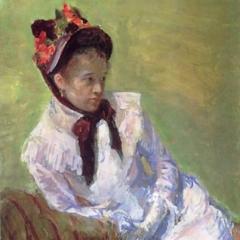
Mary Cassatt
Mary Cassatt

Mary Cassatt was an American painter known for her paintings that depicted the relationship between mothers and children. Born on May 22, 1844, and died on June 14, 1926, Cassatt spent most of her artistic career in France, where she was closely associated with the Impressionist movement, although her style was distinct and emphasized detail and emotional expression. more

You May Also Like

“I've always sought to express a tension in form and meaning in order to achieve a veracity. I have come to the conclusion that the art world has to join us, women artists, not we join it. When women are in leadership roles and gain rewards and recognition, then perhaps 'we' (women and men) can all work together in art world actions.”

“When I showed ‘Black and the Red III’ in Malmö, Sweden, it was a continuum - a band - all around the galleryseeing this huge space in the gallery in Malmö, I just took a deep breath and I put the paper around in a single band. Then I continued along, printing on the wall like a trompe l’oeil to reiterate the images in the work printed on paper that I had push-pinned to the wall. I literally took the rhythm and the images from ‘Black and the Red III’ and continued that on the wall.”

“I never thought of my work in terms of being radical, although I tried to make it radical- that is, to shift the premise of what goes for pictures on a wall. I wanted my work to say something other than the usual- the usual format for an artwork being a rectangle, a square, or anything flat, framed, and attached or hooked on the wall. That was accepted practice, mainline thinking.”