Quotessence
Home / Quotes / Quote by Terry Tempest Williams

Quote by Terry Tempest Williams

“My heart breaks living in southern Utah on the edge of America's Redrock Wilderness, witnessing what the Bush Administration's policies regarding oil and gas exploitation are doing to our public lands that belong to all Americans. Their policy is not about the public or the public's best interest. It is about the oil and gas corporations' best interests. The Secretary of the Interior is urging the Bureau of Land Management to support the gas and oil industry's most extreme drilling scenario in some of the American West's most pristine and fragile areas without proper legal and public input.”

Quote by Terry Tempest Williams

Author
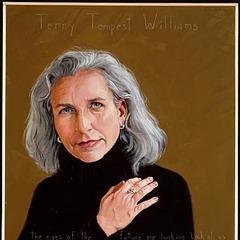
Terry Tempest Williams

Terry Tempest Williams is an American author known for her profound insights into the relationship between humans and nature. Her works often explore themes such as environmental protection, feminism, and identity. more

You May Also Like

“Community after community is rising up, ranchers, developers, environmentalists, and local commissioners, all saying this is not the best use of our public lands. It is a story that is largely unknown in the rest of the country. It is a disturbing and community-destroying example of domestic imperialism being waged against people in places deeply connected to the public lands that are our public commons. The Bush energy policy is a short-term strategy based on corporate greed instead of a sustainable vision of what best supports local economies and healthy ecosystems.”

“I see myself as a human being. You're right, I am an American, I do live in Utah, and I am deeply ashamed about the decisions our President is making around the world, in our name: the war in Iraq, his continued denial about global warming, the wholesale degradation of the environment on every level. Since September 11, 2001, I have come to believe that there are many forms of terrorism, and environmental degradation is one of them. We have to transcend our government and relate to each other as human beings first and Americans second and feel both our local and global responsibilities.”

“I was invited to give the Freshmen Convocation at Florida Gulf Coast University on October 24, 2004. My book The Open Space of Democracy had been selected as one of the "common readers" for the university's 1,050 entering freshmen. On October 6, William Merwin, the president of Florida Gulf Coast, made the decision to "postpone" the convocation. He cited negative statements I had made in print about President Bush. If our colleges and universities are no longer the champions and protectors of free speech, then no voice in this country is safe.”

“This is an incredibly creative time. It is a difficult time. It is a disparaging time. A time of cultural and global transitions based on the realization that the Earth cannot support nonsustainable practices anymore. I believe capitalism will eventually be replaced by a communitarian ethic where the rights and care of all beings will be taken into consideration, not just the greed of a corporate few.”

“Thomas Berry calls the Ecozoic Era, a time when we recognize the imperative of caring for the planet as a means of compassionate survival. We do not know what the outcome is going to be, but we have an opportunity to make these kinds of creative and imaginative leaps of thought and actions both locally and globally. This is completely antithetical to the direction George W. Bush is leading this nation. I do trust that the open space of democracy is ultimately the open space of our hearts and that we can follow our own leadership that carries a long-term view way beyond "four more years."”

“Hope is not attached to outcomes but is a state of mind, as Vaclav Havel says, "an orientation of the spirit." And I have faith; maybe more than hope, I have faith. I think of my great-grandmother, Vilate Lee Romney, who came from good pioneer Mormon stock. She always said to us that faith without works is dead, so I think if we have hope, we must work to further that hope. Maybe that is the most important thing of all, to have our faith rooted in action.”

“Hollywood is a very liberal community. There are a lot of guys that are also conservative that are frightened or fearful of being able to come out. And there's also the alternative. I'm one of the few conservatives that are involved with the Creative Coalition. It's trying to propagate the arts in schools and education, and a lot of things I believe in. It's a bipartisan thing, but when there is this strong partisanship... The other thing is, I'm pro-life, that's absolute, but I'm for live and let live. I'm an entertainer, I don't believe in stopping anyone's freedoms of lifestyle.”

“The film's title You Can't Be Neutral on a Moving Train. comes from something I used to say in teaching my students "This is not going to be a neutral class." The world is already moving in certain directions and wars are going on and children are going hungry. Terrible things are happening. And so to be neutral in a situation like this is to collaborate with whatever is going on. And I don't want to collaborate with the world as it is. I want to intrude myself. I want to participate in changing the direction of things. So that's the origin of the title.”

“I was just a seventeen-year-old kid, going to Times Square to participate in this left-wing demonstration. The signs were for peace and justice and so on. But then I was attacked by police mounted on horseback and on foot. Before I knew it, I was clubbed and knocked unconscious. So it gave me a radical view of the United States, a critical view of the role of the state and of the instruments of the state - the police, the Army, and so on - as not being neutral at all in political battles, but being generally against workers and against striking people, against dissenters of all kinds.”

“I began to think of war, even so-called "good wars" like World War II, as corrupting everybody. Violence begetting violence. The good guys beginning to act like the bad guys. And when I studied the history of wars, it seemed to me that that was the case. Athens vs. Sparta in the Peloponnesian War. The Athenians presumably the democratic state. The Spartans the totalitarian state. But as the war went on, the Athenians began to act like the Spartans. They began committing atrocities and cruelties. So I saw this as a characteristic of war, even so-called "good wars."”