Quotessence
Home / Quotes / Quote by Steven Pinker

Quote by Steven Pinker

“The moral sense is a gadget, like stereo vision or intuitions about number. It is an assembly of neural circuits cobbled together from older parts of the primate brain and shaped by natural selection to do a job. That does not mean that morality is a figment of our imagination, any more than the evolution of depth perception means that 3-D space is a figment of our imagination. [...] But it does mean that the moral sense is laden with quirks and prone to systematic error-moral illusions, as it were just like our other faculties.”

Quote by Steven Pinker

Work

The Blank Slate: The Modern Denial of Human Nature

This book delves into the debate over the influence of nature versus nurture on human behavior, examining the implications of this debate on various aspects of society and psychology. more

Author
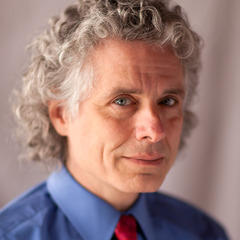
Steven Pinker
Steven Pinker

Steven Pinker is a renowned cognitive psychologist, linguist, and author. His research focuses on language, cognition, and human behavior, particularly the relationship between language and thought. Pinker is known for his in-depth research on the evolution of language and his contributions to the field of cognitive science. more

You May Also Like

“And the sceptic’s conclusion that the so-called spiritual is really derived from the natural, that it is a mirage or projection or imaginary extension of the natural, is also exactly as we should expect; for, as we have seen, this is the mistake which an observer who knew only the lower medium would be bound to make in any case of Transposition. The brutal man never can by analysis find anything but lust in love; the Flatlander never can find anything but flat shapes in a picture; physiology never can find anything in thought except twichings of the grey matter. It is no good browbeating the critic who approaches a Transposition form below. On the evidence available to him his conclusion is the only one possible. Everything is different when you approach a Transposition from above.”

“That moment was when I realized that I was wary of all men, not just those on the official suspect list. I had a deep conviction that anyone could do anything— knowing that people can kill is far different from seeing the proof. I had learned that humanity itself did not have limits. I knew the killer was a man because of the grunt I'd heard that night; so I knew that men, especially, were capable of anything. That night in the hotel, it wasn't so much that I thought my uncle might hurt me. It was that I didn't want to be vulnerable near that violent energy, however deeply buried it might be, however well checked. I thought it was possible that his shyness was a product of shame, or a subconscious disguise. I was sure there was no such thing as an entirely benevolent man.”

“All in The Mind (The Sonnet) Mind makes it dark, Mind makes it bright. Mind makes us weak, Mind gives us might. Mind makes us blind, Mind gives us sight. Mind makes us scared, Mind gives us flight. Mind makes us greedy, Mind instills charity. Mind raises the walls, Mind wills all unity. Mind is servant, mind is master. Once truly aware, mind is hatebuster.”

“Sapiens Impossible (The Sonnet) If my existence isn't impossible, I do not wanna exist. If my legacy isn't impossible, I do not want to live. If my breath doesn't breathe life, I don't wanna take another breath. If my veins don't invigorate another, I have no need for such useless veins. If my heart isn't proof of love impossible, May this be the last time my heart beats. If this being isn't the bridge of oneness, May the bugs have a feast on some good eats. I don't wanna live as a weakling of the jungle. If I must live I'll live as sapiens impossible.”