Quotessence
Home / Quotes / Quote by Walther Nernst

Quote by Walther Nernst

Author

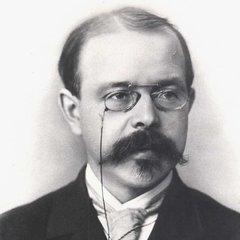
Walther Nernst
Walther Nernst

German chemist born on June 25, 1864, and died on November 18, 1941. Walther Nernst made significant contributions to thermodynamics and electrochemistry, particularly in the study of chemical potential and the third law of thermodynamics. His work had a profound impact on the development of chemistry and physics. more

You May Also Like

“But the World being once fram'd, and the course of Nature establish'd, the Naturalist, (except in some few cases, where God, or Incorporeal Agents interpose), has recourse to the first Cause but for its general and ordinary Support and Influence, whereby it preserves Matter and Motion from Annihilation or Desition; and in explicating particular phenomena, considers onely the Size, Shape, Motion, (or want of it) Texture, and the resulting Qualities and Attributes of the small particles of Matter.”

“Doctors have been exposed-you always will be exposed-to the attacks of those persons who consider their own undisciplined emotions more important than the world's most bitter agonies-the people who would limit and cripple and hamper research because they fear research may be accompanied by a little pain and suffering.”

“How did Biot arrive at the partial differential equation? [the heat conduction equation] . . . Perhaps Laplace gave Biot the equation and left him to sink or swim for a few years in trying to derive it. That would have been merely an instance of the way great mathematicians since the very beginnings of mathematical research have effortlessly maintained their superiority over ordinary mortals.”

“I feel very strongly indeed that a Cambridge education for our scientists should include some contact with the humanistic side. The gift of expression is important to them as scientists; the best research is wasted when it is extremely difficult to discover what it is all about ... It is even more important when scientists are called upon to play their part in the world of affairs, as is happening to an increasing extent.”

“If a little less time was devoted to the translation of letters by Julius Caesar describing Britain 2000 years ago and a little more time was spent on teaching children how to describe (in simple modern English) the method whereby ethylene was converted into polythene in 1933 in the ICI laboratories at Northwich, and to discussing the enormous social changes which have resulted from this discovery, then I believe that we should be training future leaders in this country to face the world of tomorrow far more effectively than we are at the present time.”