Quotessence
Home / Quotes / Quote by Aleksandr Solzhenitsyn

Quote by Aleksandr Solzhenitsyn

“An opposition is necessary and desirable for the healthy development of any country. You can scarcely find anyone in opposition, except for the communists, just like in Yeltsin's times. It is regrettable that there is still no constructive, clear and large-scale opposition in Russia. The growth and development of an opposition, as well as the maturing of other democratic institutions, will take more time and experience.”

Quote by Aleksandr Solzhenitsyn

Author
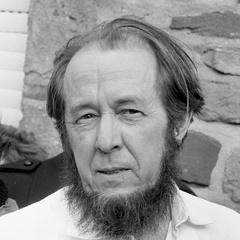
Aleksandr Solzhenitsyn

Aleksandr Solzhenitsyn, a Russian novelist, was born on December 11, 1918, and died on August 3, 2008. He is renowned for his works that profoundly exposed the dark side of the Soviet political system and is considered one of the greatest writers of the 20th century. more

You May Also Like

“I am a convinced and consistent critic of party-parliamentarism. I am for non-partisan elections of true people's representatives who are accountable to their regions and districts; and who in case of unsatisfactory work can be recalled. I do understand and respect the formation of groups on economical, cooperative, territorial, educational, professional and industrial principles, but I see nothing organic in political parties. Politically motivated ties can be unstable and quite often they have selfish ulterior motives.”

“I think the gap between the rich and the poor is a dangerous phenomenon in Russia and it needs the attention of the state. The only reasonable way to correct the situation today is not to go after big businesses, but to give breathing room to medium and small businesses. That means protecting citizens and small entrepreneurs from arbitrary rule and from corruption. It means investing the revenues from the national natural resources into the national infrastructure, education and health care. And we must learn to do so without shameful theft and embezzlement.”

“For the most part, French cities are much better preserved and looked after than British cities, because the bourgeoisie, the people who run the cities, have always lived centrally, which has only recently begun to happen in big cities in England. Traditionally in England, people who had any money would live out in the suburbs. Now, increasingly, people with money live in the cities, but this has changed only in the last 20 or so years.”

“One of the crucial underpinnings of New York as a culture capital is that there are multiple markets. There is not just one art gallery district, there are several art gallery districts. I feel that there should be art galleries and art studios in every neighborhood without exception. They should be integrated into the social and physical fabric of the streets. If we want a lively city, we can't just have high towers and dense constructions, we have to have living organisms of streets and neighborhoods. And the arts are a crucial part of that.”

“Artists have been used over and over again since the early 1980s as the legitimizers of a neighborhood in New York. And entrepreneurial artists, meaning people who themselves start out as painters, musicians, dancers, and who open a café, a bar, a restaurant, or even a co-op art gallery - they unintentionally develop the kinds of attractions that bring the middle class with some kind of cultural ambition.”

“I think the entrepreneurial activities that make art visible and attractive are what lure people into the amusement park that SoHo has become or that Bushwick or Williamsburg has become. It's not that outsiders come to an area because they hear artists are living there. A lot of people came who were not that interested in living with artists, but they were interested in living like artists and socializing the way that they thought artists socialized.”