Quotessence
Home / Quotes / Quote by James D. Watson

Quote by James D. Watson

Work

The Annotated and Illustrated Double Helix

This book is a detailed and annotated version of James Watson's groundbreaking work on the discovery of the double helix structure of DNA. It includes extensive illustrations and additional commentary that provide a deeper understanding of the scientific process and the historical context of the discovery. more

Author
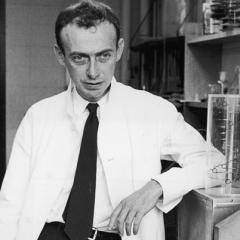
James D. Watson
James D. Watson

James D. Watson is a renowned molecular biologist, best known for his discovery of the double helix structure of DNA with Francis Crick. His research has had a profound impact on molecular biology and genetics. more

You May Also Like

“Biological determinism is, in its essence, a theory of limits. It takes the current status of groups as a measure of where they should and must be ... We inhabit a world of human differences and predilections, but the extrapolation of these facts to theories of rigid limits is ideology.”

“Metaphysical ghosts cannot be killed, because they cannot be touched; but they may be dispelled by dispelling the twilight in which shadows and solidities are easily confounded. The Vital Principle is an entity of this ghostly kind; and although the daylight has dissipated it, and positive Biology is no longer vexed with its visitations, it nevertheless reappears in another shape in the shadowy region of mystery which surrounds biological and all other questions.”

“Science is not a system of certain, or -established, statements; nor is it a system which steadily advances towards a state of finality... And our guesses are guided by the unscientific, the metaphysical (though biologically explicable) faith in laws, in regularities which we can uncover-discover. Like Bacon, we might describe our own contemporary science-'the method of reasoning which men now ordinarily apply to nature'-as consisting of 'anticipations, rash and premature' and as 'prejudices'.”

“The fundamental biological variant is DNA. That is why Mendel's definition of the gene as the unvarying bearer of hereditary traits, its chemical identification by Avery (confirmed by Hershey), and the elucidation by Watson and Crick of the structural basis of its replicative invariance, are without any doubt the most important discoveries ever made in biology. To this must be added the theory of natural selection, whose certainty and full significance were established only by those later theories.”

“The work I have done has, already, been adequately rewarded and recognized. Imagination reaches out repeatedly trying to achieve some higher level of understanding, until suddenly I find myself momentarily alone before one new corner of nature's pattern of beauty and true majesty revealed. That was my reward.”