Quotessence
Home / Quotes / Quote by John Dewey

Quote by John Dewey

“The theory of the method of knowing which is advanced in these pages may be termed pragmatic. ... Only that which has been organized into our disposition so as to enable us to adapt the environment to our needs and adapt our aims and desires to the situation in which we live is really knowledge.”

Quote by John Dewey

Work

Democracy And Education

This seminal work delves into the intersection of democracy and education, examining how democratic principles can influence and be influenced by educational institutions and curricula. The author critically analyzes the historical and contemporary aspects of democratic education, offering insights into the development of democratic societies through education. more

Author
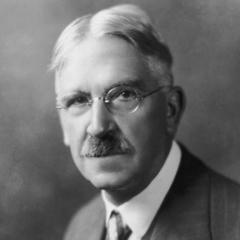
John Dewey
John Dewey

John Dewey was an American philosopher and educator, born on October 20, 1859, and died on June 1, 1952. He was a leading figure in the philosophy of pragmatism and had a profound impact on 20th-century education, philosophy, and the social sciences. more

You May Also Like

“While the law [of competition] may be sometimes hard for the individual, it is best for the race, because it insures the survival of the fittest in every department. We accept and welcome, therefore, as conditions to which we must accommodate ourselves, great inequality of environment, the concentration of business, industrial and commercial, in the hands of a few, and the law of competition between these, as being not only beneficial, but essential for the future progress of the race.”

“[A living organism] ... feeds upon negative entropy ... Thus the device by which an organism maintains itself stationary at a fairly high level of orderliness (= fairly low level of entropy) really consists in continually sucking orderliness from its environment.”

“Among the innumerable Footsteps of Divine Providence to be found in the Works of Nature, there is a very remarkable one to be observed in the exact Balance that is maintained, between the Numbers of Men and Women; for by this means it is provided, that the Species may never fail, nor perish, since every Male may have its Female, and of a proportionable Age.”

“Biologists have long attempted by chemical means to induce in higher organisms predictable and specific changes which thereafter could be transmitted in series as hereditary characters. Among microorganisms the most striking example of inheritable and specific alterations in cell structure and function that can be experimentally induced and are reproducible under well defined and adequately controlled conditions is the transformation of specific types of Pneumococcus.”

“In these strenuous times, we are likely to become morbid and look constantly on the dark side of life, and spend entirely too much time considering and brooding over what we can't do, rather than what we can do, and instead of growing morose and despondent over opportunities either real or imaginary that are shut from us, let us rejoice at the many unexplored fields in which there is unlimited fame and fortune to the successful explorer and upon which there is no color line; simply the survival of the fittest.”

“It is the very strangeness of nature that makes science engrossing. That ought to be at the center of science teaching. There are more than seven-times-seven types of ambiguity in science, awaiting analysis. The poetry of Wallace Stevens is crystal-clear alongside the genetic code.”