Quotessence
Home / Quotes / Quote by Theodore Roosevelt

Quote by Theodore Roosevelt

Work

The war in the Northwest (cont'd). The Indian wars, 1784-1787. St. Clair and Wayne

The book provides an in-depth analysis of the military campaigns and strategies employed by Generals St. Clair and Wayne during the Indian wars in the Northwest region of the United States. It covers the historical context, the battles fought, and the outcomes of these conflicts, offering a comprehensive look at the period's significant events. more

Author
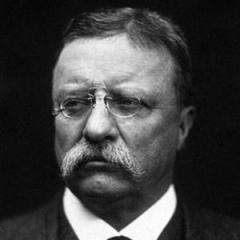
Theodore Roosevelt
Theodore Roosevelt

Theodore Roosevelt was the 26th President of the United States, serving from 1901 to 1909. A progressive leader, he is known for his advocacy of the conservation movement, expansion of federal government regulation, and efforts to improve the lives of American citizens. more

You May Also Like

“Honest good humor is the oil and wine of a merry meeting, and there is no jovial companionship equal to that where the jokes are rather small and laughter abundant.”

“No man can do both effective and decent work in public life unless he is a practical politician on the one hand, and a sturdy believer in Sunday-school politics on the other. He must always strive manfully for the best, and yet, like Abraham Lincoln, must often resign himself to accept the best possible.”

“Now, it is very necessary that we should not flinch from seeing what is vile and debasing. There is filth on the floor, and it must be scraped up with the muck rake; and there are times and places where this service is the most needed of all the services that can be performed. But the man who never does anything else, who never thinks or speaks or writes, save of his feats with the muck rake, speedily becomes, not a help but one of the most potent forces for evil.”

“One of the fundamental necessities in a representative government such as ours is to make certain that the men to whom the people delegate their power shall serve the people by whom they are elected, and not the special interests. I believe that every national officer, elected or appointed, should be forbidden to perform any service or receive any compensation, directly or indirectly, from interstate corporations; and a similar provision could not fail to be useful within the States.”

“The absence of effective State, and, especially, national, restraint upon unfair money-getting has tended to create a small class of enormously wealthy and economically powerful men, whose chief object is to hold and increase their power. The prime need is to change the conditions which enable these men to accumulate power which is not for the general welfare that they should hold or exercise. We grudge no man a fortune which represents his own power and sagacity, when exercised with entire regard to the welfare of his fellows.”

“The Americans of other blood must remember that the man who in good faith and without reservations gives up another country for this must in return receive exactly the same rights, not merely legal, but social and spiritual, that other Americans proudly possess. We of the United States belong to a new and separate nationality. We are all Americans and nothing else, and each, without regard to his birthplace, creed, or national origin, is entitled to exactly the same rights as all other Americans.”

“The effort to make financial or political profit out of the destruction of character can only result in public calamity. Gross and reckless assaults on character, whether on the stump or in newspaper, magazine, or book, create a morbid and vicious public sentiment, and at the same time act as a profound deterrent to able men of normal sensitiveness and tend to prevent them from entering the public service at any price.”

“The immigrant must not be allowed to drift or to be put at the mercy of the exploiter. Our object is not to imitate one of the older racial types, but to maintain a new American type and then to secure loyalty to this type. We cannot secure such loyalty unless we make this a country where men shall feel that they have justice and also where they shall feel that they are required to perform the duties imposed upon them.”