Quotessence
Home / Quotes / Quote by Origen

Quote by Origen

“The Church received from the apostles the tradition of giving baptism even to infants. The apostles, to whom were committed the secrets of the divine sacraments, knew there are in everyone innate strains of [original] sin, which must be washed away through water and the Spirit”

Quote by Origen

Author
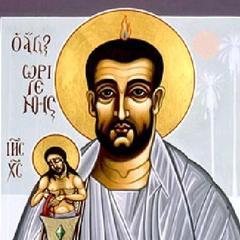
Origen
Origen

Origen (c. 182 – c. 254 AD) was an early Christian theologian, biblical scholar, and philosopher born in Alexandria, Egypt. He is considered one of the most influential Church Fathers, known for his allegorical interpretation of Scripture and systematic theology. Origen founded the renowned Catechetical School of Alexandria, where he taught many students. His major work, 'On First Principles,' is the first systematic theological treatise in Christianity. Although some of his views were later condemned as heretical, his contributions to biblical criticism, theology, and Christian philosophy remain significant. He died in Tyre, likely due to injuries from earlier persecution. more

You May Also Like

“You see how many are the benefits of baptism, and some think its heavenly grace consists only in the remission of sins, but we have enumerated ten honors [it bestows]! For this reason we baptize even infants, though they are not defiled by [personal] sins, so that there may be given to them holiness, righteousness, adoption, inheritance, brotherhood with Christ, and that they may be his [Christ's] members”

“All religions, arts and sciences are branches of the same tree. All these aspirations are directed toward ennobling man's life, lifting it from the sphere of mere physical existence and leading the individual towards freedom.”

“Exact science and its practical movements are no checks on the greatest poet, but always his encouragement and support ... The sailor and traveller, the anatomist, chemist, astronomer, geologist, phrenologist, spiritualist, mathematician, historian and lexicographer are not poets, but they are the lawgivers of poets and their construction underlies the structure of every perfect poem.”

“Gradually, ... the aspect of science as knowledge is being thrust into the background by the aspect of science as the power of manipulating nature. It is because science gives us the power of manipulating nature that it has more social importance than art. Science as the pursuit of truth is the equal, but not the superior, of art. Science as a technique, though it may have little intrinsic value, has a practical importance to which art cannot aspire.”

“I feel that, in a sense, the writer knows nothing any longer. He has no moral stance. He offers the reader the contents of his own head, a set of options and imaginative alternatives. His role is that of a scientist, whether on safari or in his laboratory, faced with an unknown terrain or subject. All he can do is to devise various hypotheses and test them against the facts.”

“Indeed, we need not look back half a century to times which many now living remember well, and see the wonderful advances in the sciences and arts which have been made within that period. Some of these have rendered the elements themselves subservient to the purposes of man, have harnessed them to the yoke of his labors and effected the great blessings of moderating his own, of accomplishing what was beyond his feeble force, and extending the comforts of life to a much enlarged circle, to those who had before known its necessaries only.”