Quotessence
Home / Quotes / Quote by Stephen Jay Gould

Quote by Stephen Jay Gould

“Anything, even the conceptually most complex material, can be written for general audiences without any dumbing down. Of course you have to explain things carefully. This goes back to Galileo, who wrote his great books as dialogues in Italian, not as treatises in Latin. And to Darwin, who wrote The Origin of Species for general readers. I think a lot of people pick up Darwin's book and assume it must be a popular version of some technical monograph, but there is no technical monograph. That's what he wrote. So what I'm doing is part of a great humanistic tradition.”

Quote by Stephen Jay Gould

Author
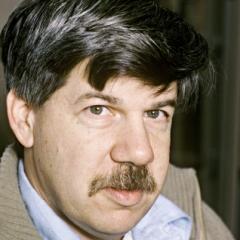
Stephen Jay Gould
Stephen Jay Gould

Stephen Jay Gould was a renowned paleontologist, evolutionary theorist, science writer, and academic. He is known for his work in ornithology, paleontology, evolutionary theory, and speciation. Gould's writings and papers have had a profound impact on the scientific community, and he was a long-time contributor to the journal 'Nature'. more

You May Also Like

“Darwin's principle of natural selection leads to the prediction that the proper way to analyze any evolutionary development is to see the new features as adaptive to environments. And that's a perfectly good principle. The problem is that there are many evolutionary biologists who view everything that happens in evolution as directly evolved for adaptive benefit. And that just doesn't work. Whenever you build a structure for adaptive reasons, the structure is going to exhibit properties that have nothing to do with adaptation. They're just side consequences.”

“People are storytelling creatures. We like stories that go somewhere, and therefore we like trends - because trends are things that either get better or get worse, so we can either rejoice or lament. But we mistakenly depict many things as trends moving in some direction. We take the "full house" of variation in a system and try to represent it as a single number, when in fact what we should be doing is studying the variation as it expands and contracts. If you look at the history of the variation in all its complexity, then you see there's no trend.”

“How did scientists get money in the past? They were either lucky and independently wealthy, like Darwin, or they had patrons, like Galileo. Universities or governments have become patrons only in the last few generations. Many of the great scientists of the past were in debt to their patrons in the same sense that modern scientists are influenced by what their granting agencies want.”

“It's true that the level of scientific knowledge among adults is very low, but that's not because there isn't a natural interest. I think most kids are fascinated by the natural world. I've often said that if you could quantify the mental power involved in all the dinosaur names correctly known and correctly spelled by 5-year-old kids in America, you could move any mountain on earth.”

“I think a lot of the intention of bands, especially in the last year, is to spread themselves out geographically and borrow from different cultures and different sounds, and to be eclectic. And that's great in terms of dynamics, but it also tends to not have that torpedo and fire running through it. If you're spreading yourself out across the globe, you're also not emphasizing a singular point, which I think great rock music has always done.”

“I've always been a fan first and foremost - obsessing over bands and seeking out bands, and spending hours and hours listening. When I played music, the scope of my fandom became more myopic; I was focusing on the bands we were touring with, or the bands on the label. And you're always positing yourself in relation to other bands. Since I haven't been playing, I feel a little less cynical. I'm able to seek out music and approach it strictly as a fan.”

“The school systems at my childhood had enough money or enough parent involvement that they felt like learning music and songs, and exploring the whole pop or classical canon, were just as important as algebra or biology. Music is such a visceral and tactile experience for a kid, and to just replace that with video games or something that doesn't have the same sort of physical impact would definitely be a poor choice, and have a negative impact.”