Quotessence
Home / Quotes / Quote by Albert Einstein

Quote by Albert Einstein

“For the moral attitudes of a people that is supported by religion need always aim at preserving and promoting the sanity and vitality of the community and its individuals, since otherwise this community is bound to perish. A people that were to honour falsehood, defamation, fraud, and murder would be unable, indeed, to subsist for very long.”

Quote by Albert Einstein

Work

Ideas and Opinions

Ideas and Opinions is a compilation of essays and articles written by Albert Einstein, offering insights into his thoughts on science, philosophy, and various social issues. The book provides a glimpse into Einstein's intellectual journey and his reflections on the world around him. more

Author

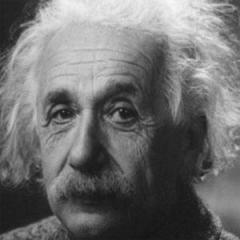
Albert Einstein
Albert Einstein

Albert Einstein, a German-born theoretical physicist, is renowned for his work on relativity and the photoelectric effect. His contributions revolutionized our understanding of the universe and had a profound impact on modern physics. more

You May Also Like

“The clergy ... believe that any portion of power confided to me [as President] will be exerted in opposition to their schemes. And they believe rightly: for I have sworn upon the altar of God, eternal hostility against every form of tyranny over the mind of man. But this is all they have to fear from me: and enough, too, in their opinion.”

“Millions of innocent men, women and children, since the introduction of Christianity, have been burnt, tortured, fined and imprisoned; yet we have not advanced one inch towards uniformity. What has been the effect of coercion? To make one half the world fools, and the other half hypocrites. To support roguery and error all over the earth.”

“I have never conceived that having been in public life required me to belie my sentiments, or to conceal them. Opinion and the just maintenance of it shall never be a crime in my view, nor bring injury on the individual. I never will by any word or act, bow to the shrine of intolerance. I never had an opinion in politics or religion which I was afraid to own; a reserve on these subjects might have procured me more esteem from some people, but less from myself.”

“I had no idea, however, that in Pennsylvania, the cradle of toleration and freedom of religion, it [fanaticism] could have arisen to the height you describe. This must be owing to the growth of Presbyterianism. The blasphemy of the five points of Calvin, and the impossibility of defending them, render their advocates impatient of reasoning, irritable, and prone to denunciation.”

“Where the preamble declares, that coercion is a departure from the plan of the holy author of our religion, an amendment was proposed by inserting "Jesus Christ," so that it would read "A departure from the plan of Jesus Christ, the holy author of our religion;" the insertion was rejected by the great majority, in proof that they meant to comprehend, within the mantle of its protection, the Jew and the Gentile, the Christian and Mohammedan, the Hindoo and Infidel of every denomination.”

“To talk of immaterial existences is to talk of nothings. To say that the human soul, angels, god, are immaterial, is to say they are nothings, or that there is no god, no angels, no soul. I cannot reason otherwise: but I believe I am supported in my creed of materialism by Locke, Tracy, and Stewart. At what age of the Christian church this heresy of immaterialism, this masked atheism, crept in, I do not know. But heresy it certainly is.”

“The clergy, by getting themselves established by law and in-grafted into the machine of government, have been a very formidable engine against the civil and religious rights of man.”

“Believing with you that religion is a matter which lies solely between man and his God, that he owes account to none other for his faith or his worship, that the legislative powers of government reach actions only, and not opinions, I contemplate with sovereign reverence that act of the whole American people which declared that their legislature should 'make no law respecting an establishment of religion, or prohibiting the free exercise thereof,' thus building a wall of separation between church and State.”

“Ministers of the Gospel are excluded [from serving as Visitors of the county Elementary Schools] to avoid jealousy from the other sects, were the public education committed to the ministers of a particular one; and with more reason than in the case of their exclusion from the legislative and executive functions.”