Quotessence
Home / Quotes / Quote by John Donne

Quote by John Donne

“Annunciation Salvation to all that will is nigh; That All, which always is all everywhere, Which cannot sin, and yet all sins must bear, Which cannot die, yet cannot choose but die, Lo, faithful virgin, yields Himself to lie In prison, in thy womb; and though He there Can take no sin, nor thou give, yet He will wear, Taken from thence, flesh, which death's force may try. Ere by the spheres time was created, thou Wast in His mind, who is thy Son and Brother; Whom thou conceivst, conceived; yea thou art now Thy Maker's maker, and thy Father's mother; Thou hast light in dark, and shuts in little room, Immensity cloistered in thy dear womb.”

Quote by John Donne

Work

The Complete English Poems

Browse quotes and source details for this work. more

Author
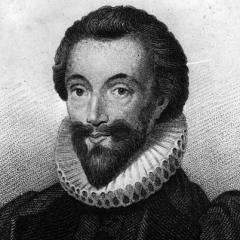
John Donne
John Donne

John Donne was a renowned 17th-century English poet, known for his profound religious and philosophical reflections. His poetry style was unique, blending the elegance of the Renaissance with the passion of the Reformation. more

You May Also Like

“But no matter how many movies we watched, we never learned their deepest lesson: they end. George Bailey finally sees his life as wonderful. Rosebud, we find out, is a sled. Travis shoots Old Yeller. One of the things that distinguishes life from movies is the pause button. We can keep Travis' finger on the trigger, the barrel staring down his Yeller, but there is no pause button for the things that matter.”

“It contrives the acceptance of injustice, crime, and falsehood by the promise of a miracle. Still greater production, still more power, uninterrupted labor, incessant suffering, permanent war, and then a moment will come when universal bondage in the totalitarian empire will be miraculously changed into its opposite: free leisure in a universal republic. Pseudo-revolutionary mystification has now acquired a formula: all freedom must be crushed in order to conquer the empire, and one day the empire will be the equivalent of freedom. And so the way to unity passes through totality.[...]Totality is, in effect, nothing other than the ancient dream of unity common to both believers and rebels, but projected horizontally onto an earth deprived of God. To renounce every value, therefore, amounts to renouncing rebellion in order to accept the Empire and slavery. Criticism of formal values cannot pass over the concept of freedom. Once the impossibility has been recognized of creating, by means of the forces of rebellion alone, the free individual of whom the romantics dreamed, freedom itself has also been incorporated in the movement of history. It has become freedom fighting for existence, which, in order to exist, must create itself. Identified with the dynamism of history, it cannot play its proper role until history comes to a stop, in the realization of the Universal City. Until then, every one of its victories will lead to an antithesis that will render it pointless. The German nation frees itself from its oppressors, but at the price of the freedom of every German. The individuals under a totalitarian regime are not free, even though man in the collective sense is free. Finally, when the Empire delivers the entire human species, freedom will reign over herds of slaves, who at least will be free in relation to God and, in general, in relation to every kind of transcendence. The dialectic miracle, the transformation of quantity into quality, is explained here: it is the decision to call total servitude freedom. Moreover, as in all the examples cited by Hegel and Marx, there is no objective transformation, but only a subjective change of denomination. In other words, there is no miracle. If the only hope of nihilism lies in thinking that millions of slaves can one day constitute a humanity which will be freed forever, then history is nothing but a desperate dream. Historical thought was to deliver man from subjection to a divinity; but this liberation demanded of him the most absolute subjection to historical evolution. Then man takes refuge in the permanence of the party in the same way that he formerly prostrated himself before the altar. That is why the era which dares to claim that it is the most rebellious that has ever existed only offers a choice of various types of conformity. The real passion of the twentieth century is servitude.”