Quotessence
Home / Quotes / Quote by Arthur Conan Doyle

Quote by Arthur Conan Doyle

Work

The Case-book of Sherlock Holmes

This book is a compilation of 56 short stories written by Sir Arthur Conan Doyle. It includes some of the most iconic cases of Sherlock Holmes, such as 'The Adventure of the Speckled Band' and 'The Adventure of the Engineer'. The stories delve into the intricate details of each case, highlighting Holmes's astute observations and deductive reasoning, while also offering insights into the social and cultural context of the late 19th century. more

Author
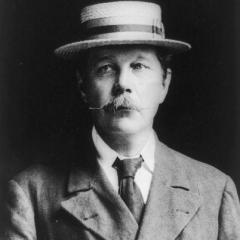
Arthur Conan Doyle
Arthur Conan Doyle

Arthur Conan Doyle, born on May 22, 1859 in Edinburgh, Scotland, was a renowned Scottish physician and writer. He is best known for his creation of the Sherlock Holmes series of detective novels, which have had a profound impact on the development of detective fiction and played a crucial role in shaping modern detective culture. more

You May Also Like

“About thirty years ago there was much talk that geologists ought only to observe and not theorise; and I well remember some one saying that at this rate a man might as well go into a gravel-pit and count the pebbles and describe the colours. How odd it is that anyone should not see that all observation must be for or against some view if it is to be of any service!”

“Almost all the greatest discoveries in astronomy have resulted from what we have elsewhere termed Residual Phenomena, of a qualitative or numerical kind, of such portions of the numerical or quantitative results of observation as remain outstanding and unaccounted for, after subducting and allowing for all that would result from the strict application of known principles.”

“As in Mathematicks, so in Natural Philosophy, the Investigation of difficult Things by the Method of Analysis, ought ever to precede the Method of Composition. This Analysis consists in making Experiments and Observations, and in drawing general Conclusions from them by Induction, and admitting of no Objections against the Conclusions, but such as are taken from Experiments, or other certain Truths. For Hypotheses are not to be regarded in experimental Philosophy.”

“But by far the greatest hindrance and aberration of the human understanding proceeds from the dullness, incompetency, and deceptions of the senses; in that things which strike the sense outweigh things which do not immediately strike it, though they be more important. Hence it is that speculation commonly ceases where sight ceases; insomuch that of things invisible there is little or no observation.”

“Common sense is science exactly in so far as it fulfills the ideal of common sense; that is, sees facts as they are, or at any rate, without the distortion of prejudice, and reasons from them in accordance with the dictates of sound judgment. And science is simply common sense at its best, that is, rigidly accurate in observation, and merciless to fallacy in logic.”