Quotessence
Home / Quotes / Quote by Jules Verne

Quote by Jules Verne

“In spite of the opinions of certain narrow-minded people who would shut up the human race upon this globe, we shall one day travel to the Moon, the planets, and the stars with the same facility, rapidity and certainty as we now make the ocean voyage from Liverpool to New York.”

Quote by Jules Verne

Author
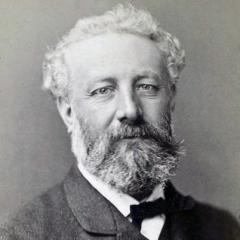
Jules Verne
Jules Verne

Jules Verne, born on February 8, 1828, in Nantes, France, and died on March 24, 1905. He was a renowned French science fiction novelist in the 19th century, known as the 'Father of Science Fiction'. Verne's works are characterized by their rich imagination and unique scientific fantasy, with notable titles such as 'Twenty Thousand Leagues Under the Sea' and 'Around the World in Eighty Days'. more

You May Also Like

“In this age of inventive wonders all men have come to believe that in some genius' brain sleeps the solution of the grand problem of aerial navigation-and along with that belief is the hope that that genius will reveal his miracle before they die, and likewise a dread that he will poke off somewhere and die himself before he finds out that he has such a wonder lying dormant in his brain. We all know the air can be navigated-therefore, hurry up your sails and bladders-satisfy us-let us have peace.”

“And then, the Earth being small, mankind will migrate into space, and will cross the airless Saharas which separate planet from planet and sun from sun. The Earth will become a Holy Land which will be visited by pilgrims from all the quarters of the Universe. Finally, men will master the forces of Nature; they will become themselves architects of systems, manufacturers of worlds.”

“I hold that in the flight of the soaring birds (the vultures, the eagles, and other birds which fly without flapping) ascension is produced by the skillful use of the force of the wind, and the steering, in any direction, is the result of skillful manoeuvres; so that by a moderate wind a man can, with an aeroplane, un- provided with any motor whatever, rise up into the air and direct himself at will, even against the wind itself.”

“To set foot on the soil of the asteroids, to lift by hand a rock from the Moon, to observe Mars from a distance of several tens of kilometers, to land on its satellite or even on its surface, what can be more fantastic? From the moment of using rocket devices a new great era will begin in astronomy: the epoch of the more intensive study of the firmament.”

“To the possible enquiry as to the probable character of a successful flying machine, the writer would answer that in his judgment two types of such machines may eventually be evolved: one, which may be termed the soaring type, and which will carry but a single operator, and another, likely to be developed somewhat later, which may be termed the journeying type, to carry several passengers, and to be provided with a motor.”