Quotessence
Home / Quotes / Quote by Wilfred Owen

Quote by Wilfred Owen

Work

The Collected poems of Wilfred Owen

This book gathers together the works of Wilfred Owen, showcasing his poignant and evocative poetry that captures the horrors and complexities of war. Owen's collection is a significant contribution to the literary landscape of the early 20th century, reflecting the human experience during a tumultuous period. more

Author
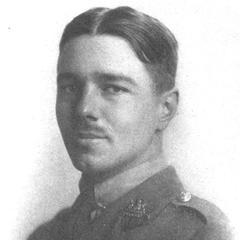
Wilfred Owen
Wilfred Owen

Wilfred Owen was an English poet renowned for his works during World War I. His poetry vividly depicted the cruelty and suffering of soldiers, becoming a classic in war literature. more

You May Also Like

“At 8 o'clock in the morning a dense throng of workers - almost 10,000 - assembled in the square, which the police had already occupied well ahead of time. Karl Liebknecht's voice then rang out: 'Down with the War! Down with the Government!' The police immediately rushed at him. For the first time since the beginning of the war open resistance to it had appeared on the streets of the capital. The ice was broken.”

“The storm lashes us, out of the confusion of grey and yellow the hail of splinters whips forth the childlike cries of the wounded, and in the night shattered life groans painfully into silence. Our hands are earth, our bodies clay and our eyes pools of rain. We do not know whether we are still alive.”

“As a result of continuous work with these highly toxic substances, our minds were so numbed that we no longer had any scruples about the whole thing. Anyway, our enemies had by now adopted our methods and as they became increasingly successful in this mode of warfare we were no longer exclusively the aggressors, but found ourselves more and more at the receiving end.”

“Until the dead are buried they change somewhat in appearance each day. The color change in Caucasian races is from white to yellow, to yellow-green, to black. If left long enough in the heat the flesh comes to resemble coal-tar, especially where it has been broken or torn, and it has quite a visible tarlike iridescence. The dead grow larger each day until sometimes they become quite too big for their uniforms, filling these until they seem blown tight enough to burst. The individual members may increase in girth to an unbelievable extent and faces fill as taut and globular as balloons.”