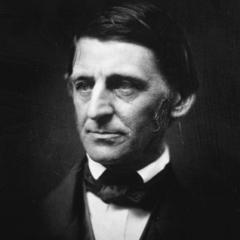
“I take this evanescence and lubricity of all objects, which lets them slip through our fingers then when we clutch hardest, to be the most unhandsome part of our condition.”
Quote by Ralph Waldo Emerson
“I find it a great and fatal difference whether I court the Muse, or the Muse courts me. That is the ugly disparity between age and youth.”
Source: The Heart of Emerson's Journals
“Be cheerful, also, and seek not external help, nor the peace which others give. A man must stand straight, and not be kept straight by others.”
“Consider when thou art much vexed or grieved, that man's life is only a moment, and after a short time we are all laid out dead.”
Source: Stoic Six Pack: Meditations of Marcus Aurelius, Golden Sayings, Fragments and Discourses of Epictetus, Letters from a Stoic and The Enchiridion
“Does the light of the lamp shine without losing its splendour until it is extinguished; and shall the truth which is in thee and justice and temperance be extinguished before thy death?”
Source: Stoic Six Pack: Meditations of Marcus Aurelius, Golden Sayings, Fragments and Discourses of Epictetus, Letters from a Stoic and The Enchiridion
“Enough of this wretched life and murmuring and apish tricks. Why art thou disturbed? What is there new in this? What unsettles thee? Is it the form of the thing? Look at it. Or is it the matter? Look at it. But besides these there is nothing. Towards the gods, then, now become at last more simple and better. It is the same whether we examine these things for a hundred years or three.”
Source: Thoughts of Marcus Aurelius Antoninus
“How many after being celebrated by fame have been given up to oblivion; and how many who have celebrated the fame of others have long been dead.”
Source: Stoic Six Pack: Meditations of Marcus Aurelius, Golden Sayings, Fragments and Discourses of Epictetus, Letters from a Stoic and The Enchiridion
“If any man has done wrong, the harm is his own. But perhaps he has not done wrong.”
Source: Meditations
“If any man should conceive certain things as being really good, such as prudence, temperance, justice, fortitude, he would not after having first conceived these endure to listen to anything which should not be in harmony with what is really good.”
Source: Stoic Six Pack: Meditations of Marcus Aurelius The Golden Sayings Fragments and Discourses of Epictetus Letters from a Stoic and The Enchiridion
“If this is neither my own badness, nor an effect of my own badness, and the common weal is not injured, why am I troubled about it? And what is the harm to the common weal?”
Source: Stoic Six Pack: Meditations of Marcus Aurelius, Golden Sayings, Fragments and Discourses of Epictetus, Letters from a Stoic and The Enchiridion
“In one way an arrow moves, in another way the mind. The mind indeed, both when it exercises caution and when it is employed about inquiry, moves straight onward not the less, and to its object.”
Source: Stoic Six Pack: Meditations of Marcus Aurelius, Golden Sayings, Fragments and Discourses of Epictetus, Letters from a Stoic and The Enchiridion