Quotessence
Home / Quotes / Quote by Andy Rooney

Quote by Andy Rooney

“Those to whom his word was revealed were always alone in some remote place, like Moses. There wasn't anyone else around when Mohammed got the word either. Mormon Joseph Smith and Christian Scientist, Mary Baker Eddy, had exclusive audiences with God. We have to trust them as reporters--and you know how reporters are. They'll do anything for a story.”

Quote by Andy Rooney

Author
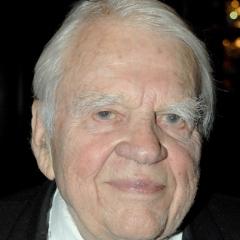
Andy Rooney
Andy Rooney

Andy Rooney was an American writer renowned for his sharp wit and humor. He was a regular contributor to '60 Minutes' on CBS, where he shared his opinions and observations on a wide range of topics. Rooney's writing style was characterized by its conversational tone and his ability to find humor in everyday situations. more

You May Also Like

“Let's face a historical truth: we have never had a "free market", we have always had government intervention in the economy, and indeed that intervention has been welcomed by the captains of finance and industry. They had no quarrel with "big government" when it served their needs.”

“Physical science enjoys the distinction of being the most fundamental of the experimental sciences, and its laws are obeyed universally, so far as is known, not merely by inanimate things, but also by living organisms, in their minutest parts, as single individuals, and also as whole communities. It results from this that, however complicated a series of phenomena may be and however many other sciences may enter into its complete presentation, the purely physical aspect, or the application of the known laws of matter and energy, can always be legitimately separated from the other aspects.”

“The historian of science may be tempted to claim that when paradigms change, the world itself changes with them. Led by a new paradigm, scientists adopt new instruments and look in new places. even more important, during revolutions, scientists see new and different things when looking with familiar instruments in places they have looked before. It is rather as if the professional community had been suddenly transported to another planet where familiar objects are seen in a different light and are joined by unfamiliar ones as well.”

“The resolution of revolutions is selection by conflict within the scientific community of the fittest way to practice future science. The net result of a sequence of such revolutionary selections, separated by periods of normal research, is the wonderfully adapted set of instruments we call modern scientific knowledge.”