Quotessence
Home / Quotes / Quote by Pope Pius XII

Quote by Pope Pius XII

Work

Author

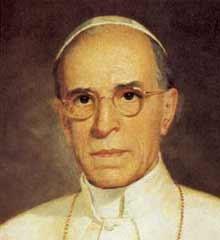
Pope Pius XII
Pope Pius XII

Pope Pius XII, born Giuseppe Angelo Raffaele Carlo Maria Radziwill, was the 259th Pope, serving from 1939 to 1958. His papacy coincided with World War II, and his role during the war has been widely controversial. more

You May Also Like

“When a lull came in the conversation he sat up in bed with vigor and said: "Does not all this explain that mysterious passage in the Gospel which tells how Mary placed her 'firstborn' in the manger? So many have mistakenly believed that that word implies that she was to have other children. We know she was to have millions on millions but not according to the flesh; only in the spirit. Jesus was her only Son in one sense, but all men are her children in the other." "Exactly," said the young scholar. "In one of his encyclicals, Pius X told how Mary, carrying Jesus in her womb, was carrying each of us spiritually; for in carrying the Head of the Mystical Body physically, she was carrying the whole Mystical Body spiritually." (Chapter 2)”

“On all these grounds it is excellent that after the Heart of Jesus there is nothing among corporeal things either in Heaven or on earth that can be compared in excellence with the Heart of Mary - nothing holier, nothing more precious, nothing nobler, nothing greater, nothing sweeter, nothing more pleasing to God. And if we now go on to consider this admirable Heart in relation to men, to whom it is presented as an object of devotion, where shall we find anything sweeter or more tenderly than this virginal Heart? For it is the Heart of our heavenly mistress, our good Mother, our advocate, our consolation, our refuge; the source and seat of the charity, compassion, mercy and tender love of the Blessed Virgin for us; the centre of those unmeasured sorrows that our Blessed Mother suffered on the occasion of our redemption; finally, the model according to which we should form our hearts, the model of humility, purity, meekness, charity, love, and all other virtues.”

“The theology of the messages is profoundly Catholic. The Blessed Virgin Mary, Mother of God, is revealed as the Mediatrix of all graces. So prominent is She in Heaven's designs that "the justice of God condemns" those who commit sins against Her. Moreover, She is authorized to promise salvation to those who practice the First Five Saturdays reparatory devotion. Devotion to her Immaculate Heart is given as the signal remedy to reduce the number of souls who are damning themselves to hell. In the vision at Tuy Mary stands at the foot of the Cross, Her Immaculate Heart crowned with thorns and bursting with flames. The striking image emphasizes Mary's role as Co-redemptrix of mankind.”

“I believe that it is dangerous for a young person simply to go from achieving goal after goal, generally being praised along the way. So it is good for a young person to experience his limit, occasionally to be dealt with critically, to suffer his way through a period of negativity, to recognise his own limits himself, not simply to win victory after victory. A human being needs to endure something in order to learn to assess himself correctly, and not least to learn to think with others. Then he will not simply judge others hastily and stay aloof, but rather accept them positively, in his labours and his weaknesses.”

“Pope Benedict XVI on Pope St Paul VI: Let us pay homage to the spirit of evangelical wisdom with which my beloved predecessor was able to guide the Church during and after the Second Vatican Council. With prophetic intuition he perceived the hopes and anxieties or the people at that time; he strove to make the most of the positive experiences, seeking to illuminate them with the light of truth and the love of Christ.”

“One imagines that similar scenes of joy erupted throughout the world wherever two or three faithful Catholics gathered together. In contrast, the election of Ratzinger was greeted with grief and horror by those heretical theologians and cafeteria Catholics whose heresies and backsliding equivocations had been condemned by the new Pope during his many years as Prefect of the Congregation for the Doctrine of the Faith. As usual, these wolves in sheep’s clothing howled in unison with the wolves in the secular media, uniting themselves with the avowed enemies of the Church in their hatred of the hero of orthodoxy who had forced them into retreat during his years as John Paul II’s faithful and fearless servant. In the war of words that followed the Pope’s election, the enemies of orthodoxy decried the new German shepherd as “God’s Rottweiler.” Although the gentle and saintly Ratzinger did not deserve such an epithet, it is ironically apt that the wolves who would devour the flock should hate the Rottweiler who had courageously stopped them from doing so!”

“It had been a simpler time, when she could run carefree around the bailey, pretending to slay dragons and capture magical wisps. A time when she did not have to worry about betrothals, peace alliances, or any of the other duties she was now being forced to contend with as princess. But she would not have to worry about these duties for long. After Merida taught her how to survive the journey to Northumbria, she would have the freedom to study the region's fascinating artwork and listen to the poets who recited sonnets day in and day out. The freedom to spend her mornings tending to lost or injured animals, and her evenings singing folk songs with all the like-minded new friends she would meet.”