Quotessence
Home / Quotes / Quote by Gregory A. Boyd

Quote by Gregory A. Boyd

“When we interpret the violent portraits of God through the lens of the cross, we can see God doing in history what he did in a supreme way on Calvary. And this is how these violent divine portraits anticipate, and point us toward, the cross.”

Quote by Gregory A. Boyd

Author
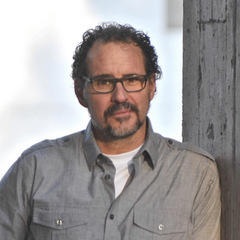
Gregory A. Boyd
Gregory A. Boyd

Gregory A. Boyd, born on June 2, 1957, is a pastor whose theological views have had a profound impact on the Christian community. more

You May Also Like

“Accommodation is a central aspect of the cross-centered interpretation of violent portraits of God that I'm advocating. Like everything else in Cross Vision, this concept is anchored in the cross. On the cross, God stoops to meet us, and to enter into solidarity with us, right where we are at, which is in bondage to sin and to Satan. And he does this to free us and to bring us where he wants us to be, which is united with him in Christ. The cross is thus the paradigmatic example of God mercifully stooping to accommodate people in their fallen conditioning.”

“Jesus clearly believed in the reality of Satan and other principalities and powers. Now, I have very compelling historical, philosophical, and existential reasons for concluding that Jesus is Lord, and if I confess him to be Lord, I don't see how I can consider myself in a position to ever correct his theology, especially about such a foundational theological matter!”

“By the time Kafka was seven or eight years old, he already had a relatively dark view of the world derived from experiences in his own family. This told him that the world was organized in a strictly hierarchical manner and that those on the top were allowed to mete out punishment in any way they chose. They were entitled to leave those on the bottom uninformed about the rules to which they subscribed; they weren't even required to follow their own rules - this is how Kafka described it in his later Letter to My Father.”

“Second, if you disbelieve in the reality of good and evil spirit agents, you fundamentally change the narrative of Scripture. The motif of spiritual warfare is a through-line of both the Old and New Testaments (NT). And in the NT, the meaning of what Jesus was doing in his life, ministry, death and resurrection is fundamentally tied up with the belief in spiritual warfare. Take away Satan, and you take away one of the most fundamental reasons Jesus came to earth!”

“Kafka often describes himself as a bloodless figure: a human being who doesn't really participate in the life of his fellow human beings, someone who doesn't actually live in the true sense of the word, but who consists rather of words and literature. In my view, that is, however, only half true. In a roundabout way through literature, which presupposes empathy and exact observation, he immerses himself again in the life of society; in a certain sense he comes back to it.”

“Kafka was certainly one of the great literary talents of the twentieth century, but he did not find his way to his own style until the age of nearly 30, so rather late. The disciplined immersion in unconscious psychical material is something he also learned only after long years of practice. When he succeeded in doing it for the first time - in the story The Judgement - it put him in a euphoric mood. He wanted to experience this again and again; the act of creation made him happy and proud.”

“Civil society people - these are the people - civil society groups are the people who need to monitor the aid to ensure that the aid is directed to what it is supposed to. And in order for them to do so, they need to have the space, they need to have the freedom, and they need to have the right to demonstrate, and to petition their government. They can't do that in Ethiopia; they can't do that in Eritrea; and so this is why I was cautioning that we may be repeating some of our old mistakes.”