Quotessence
Home / Quotes / Quote by Erich Fromm

Quote by Erich Fromm

“A society whose principles are acquisition, profit, and property produces a social character oriented around having, and once the dominant pattern is established, nobody wants to be an outsider, or indeed an outcast; in order to avoid this risk everybody adapts to the majority, who have in common only their mutual antagonism.”

Quote by Erich Fromm

Work

To Have Or To Be?

This book delves into profound questions about the essence of life, exploring the distinction between the materialistic pursuit of 'having' and the existential quest for 'being'. It examines the human experience and the search for meaning in a world that often emphasizes accumulation over authenticity. more

Author

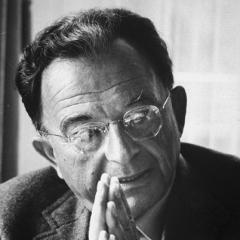
Erich Fromm
Erich Fromm

Erich Fromm, born on March 23, 1900 in Germany and died on March 18, 1980, was a renowned psychologist. His research covered a wide range of fields including anthropology, philosophy, and religion, particularly known for his studies on human psychology and interpersonal relationships. more

You May Also Like

“Society, and the family as its psycho social agent, has to solve a difficult problem: How to break a person's will without his being aware of it? Yet by a complicated process of indoctrination, rewards, punishments, and fitting ideology, it solves this task by and large so well that most people believe they are following their own will and are unaware that their will itself is conditioned and manipulated.”

“Paying attention at every moment, forms a new relationship to time. In some magical way, by slowing down, you become more efficient, productive, and energetic, focusing without distraction directly on the task in front of you. Not only do you become immersed in the moment, you become that moment.”

“There is no formula. We all must become spirited inventors. There's no single answer - not even a single starting point. Even the 'teachers' ... don't offer us the answer. They do offer us approaches, ways of thinking, possibilities we can adapt, and hope that might generate in us wholly new ideas.”