Quotessence
Home / Quotes / Quote by Theodor Adorno

Quote by Theodor Adorno

Work

Minima Moralia: Reflections on a Damaged Life

Hermann Broch's Minima Moralia is a collection of philosophical essays that delve into the intricacies of human existence and the challenges of contemporary life. The essays, written in German and translated into English, are characterized by their introspective nature and their exploration of the author's personal experiences. Broch's work is known for its depth of thought and its ability to connect philosophical ideas with everyday life. more

Author
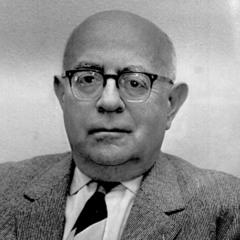
Theodor Adorno
Theodor Adorno

Theodor Adorno was a German sociologist, philosopher, and musicologist. He is renowned for his critical theory, co-developed with Max Horkheimer and other members of the Frankfurt School. Adorno's research focused on the analysis of modern society, culture, and the influence of mass culture on individuals. more

You May Also Like

“We are often like rivers: careless and forceful, timid and dangerous, lucid and muddied, eddying, gleaming, still. Lovers, farmers, and artists have one thing in common, at least - a fear of 'dry spells,' dormant periods in which we do no blooming, internal droughts only the waters of imagination and psychic release can civilize.”

“A black-crowned night heron stood on an apron of wet sand, looking across the channel. The feather plume at the back of his head lifted in a faint breeze. Out there the channel churned its cyclonic eddies counterclockwise. Schools of anchovies, halibut, and sea bass came and went: silver flashes, small storms that well up from the inside of the sea but are short-lived, like lightning.”

“As fog moved to the mainland I heard a flock of birds fly over. They sounded like a dress rustling, a dress being unfastened and dropping to the floor. Fog came unpinned like hair. On the beach cliffs, great colonies of datura - jimson weed - with their white trumpet flowers, looked like brass bands.”

“All that's known is this: there is no central processor, no single computer. Nothing that simple. Millions of neurons process information simultaneously and in parallel, not linearly, but the actual chemistry and electrical properties of that integrative process are still being mapped. Even so, it seems odd that during the evolution of brain circuitry and thinking, the ability to understand itself did not get wired in. Such built-in innocence seems like a terrible oversight.”

“June marked the end of spring on California's central coast and the beginning of five months of dormancy that often erupted in fire. Mustard's yellow robes had long since turned red, then brown. Fog and sun mixed to create haze. The land had rusted. The mountains, once blue-hued with young oaks and blooming ceanosis, were tan and gray. I walked across the fallen blossoms of five yucca plants: only the bare poles of their stems remained to mark where their lights had shone the way.”