Quotessence
Home / Quotes / Quote by Carl Sagan

Quote by Carl Sagan

Work

Broca's brain: reflections on the romance of science

This book delves into the fascinating world of neuroscience, examining the evolution of scientific understanding of the brain and its intricate workings. The author combines historical accounts with personal reflections, offering a unique perspective on the romance and challenges of scientific discovery. more

Author
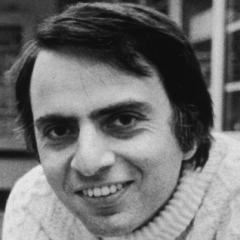
Carl Sagan
Carl Sagan

Carl Sagan was an American astronomer, cosmologist, author, and science communicator, born on November 9, 1934, in Brooklyn, New York. He is renowned for his profound research into the cosmos and his dedication to popularizing science. Sagan proposed numerous theories about the origin of the universe and life, and he made complex scientific knowledge accessible to the public with his unique perspective and clear, engaging writing style. more

You May Also Like

“In the Middle Ages people believed that the earth was flat, for which they had at least the evidence of their senses: we believe it to be round, not because as many as 1 percent of us could give physical reasons for so quaint a belief, but because modern science has convinced us that nothing that is obvious is true, and that everything that is magical, improbable, extraordinary, gigantic, microscopic, heartless, or outrageous is scientific.”

“Because we do not understand the brain very well we are constantly tempted to use the latest technology as a model for trying to understand it. In my childhood we were always assured that the brain was a telephone switchboard...Sherrington, the great British neuroscientist, thought the brain worked like a telegraph system. Freud often compared the brain to hydraulic and electromagnetic systems. Leibniz compared it to a mill...At present, obviously, the metaphor is the digital computer.”

“Real progress in understanding nature is rarely incremental. All important advances are sudden intuitions, new principles, new ways of seeing. We have not fully recognized this process of leaping ahead, however, in part because textbooks tend to tame revolutions...They describe the advances as if they had been logical in their day, not all shocking.”