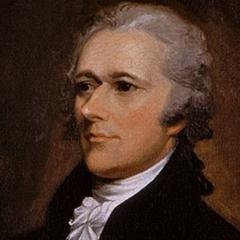
“The constitution of human nature" teaches us not to expect "that the persons, entrusted with the administration of the affairs of the particular members of a confederacy, will at all times be ready, with perfect good humor, and an unbiased regard to the public weal, to execute the resolutions of decrees of the general authority." "This tendency is not difficult to be accounted for," Publius argues, "It has its origin in the love of power.”
Quote by Alexander Hamilton

Alexander HamiltonAlexander Hamilton was a Founding Father of the United States, born on January 11, 1757, and died on July 12, 1804. He played a crucial role in the American Revolutionary War and was instrumental in the drafting of the U.S. Constitution. As the first Secretary of the Treasury, Hamilton promoted fiscal stability and economic growth, establishing the First Bank of the United States and proposing solutions for federal debt. His ideas and policies had a profound impact on the early political and economic development of the United States. more
“Nothing is more natural to men in office, than to look with peculiar deference towards that authority to which they owe their official existence.”
Source: The Federalist Papers: A Collection of Essays Written in Favour of the New Constitution
“Man is very much a creature of habit. A thing that rarely strikes his senses will generally have but little influence upon his mind. A government continually at a distance and out of sight, can hardly be expected to interest the sensations of the people. The inference is, that the authority of the Union, and the affections of the citizens towards it, will be strengthened rather than weakened by its extension to what are called matters of internal concern.”
Source: America's Founding Documents: The Declaration of Independence, the Articles of Confederation, the United States Constitution, the Federalist Papers, and the Bill of Rights
“The obscurity is much oftener in the passions and prejudices of the reasoner than in the subject.”
“Common interest may always be reckoned upon as the surest bond of sympathy.”
Source: The Federalist on the New Constitution, Written in the Year 1788, with an Appendix Containing the Letters of Pacificus and Helvidius on the Proclamation of Neutrality of 1793
“Necessity, especially in politics, often occasions false hopes, false reasonings, and a system of measures, correspondingly erroneous.”
Source: The federalist papers
“With regard to the learned professions, little need be observed; they truly form no distinct interest in society . . . [discussing the landed, merchant, and learned classes in legislative assembly]. Will not the man of the learned profession, who will feel a neutrality to the rivalships between the different branches of industry, be likely to prove an impartial arbiter between them, ready to promote either, so far as it shall appear to him conducive to the general interests of society?”
“Happy will it be for ourselves, and most honorable for human nature, if we have wisdom and virtue enough to set so glorious an example to mankind!”
Source: The Essential Federalist: A New Reading of the Federalist Papers
“Would there not be the greatest reason to apprehend, that error in the first sentence would be the parent of error in the second sentence? That the strong bias of one decision would be apt to overrule the influence of any new lights, which might be brought to vary the complexion of another decision? Those, who know any thing of human nature, will not hesitate to answer these questions in the affirmative.”
Source: The Origin of the Nation: Declaration of Independence, Constitution, Bill of Rights and Other Amendments, Federalist Papers & Common Sense: Creating America - Landmark Documents that Shaped a New Nation
“When men, engaged in unjustifiable pursuits, are aware that obstructions may come from a quarter which bare apprehension of opposition from doing what they would with eagerness rush into if no such external impediments were to be feared.”
Source: The Federalist on the New Constitution
“The propriety of a law, in a constitutional light, must always be determined by the nature of the powers upon which it is founded.”
Source: The Federalist, on the New Constitution, Written in the Year 1788