Quotessence
Home / Quotes / Quote by James Madison

Quote by James Madison

Work

James Madison's

This book delves into the life and contributions of James Madison, focusing on his role in drafting the United States Constitution and his influence on American political thought. It examines his early life, education, and political career, providing insight into his ideas on federalism, separation of powers, and the role of the judiciary. more
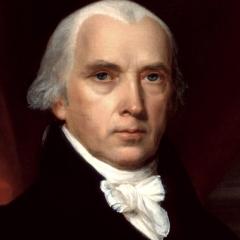
Author

James Madison
James Madison

James Madison, the 4th President of the United States, was born on March 16, 1751, and died on June 28, 1836. He was a key figure in drafting the U.S. Constitution and had a profound impact on the political system of the United States. more

You May Also Like

“I have found strength where one does not look for it: in simple, mild, and pleasant people, without the least desire to rule -- and, conversely, the desire to rule has often appeared to me a sign of inward weakness: they fear their own slave soul and shroud it in a royal cloak (in the end, they still become the slaves of their followers, their fame, etc.)”

“The question of place and climate is most closely related to the question of nutrition. Nobody is free to live everywhere; and whoever has to solve great problems that challenge all his strength actually has a very restricted choice in this matter. The influence of climate on our metabolism, its retardation, its acceleration, goes so far that a mistaken choice of place and climate can not only estrange a man from his task but can actually keep it from him: he never gets to see it.”

“Art is a creative effort of which the wellsprings lie in the spirit, and which brings us at once the most intimate self of the artist and the secret concurrences which he has perceived in things by means of a vision or intuition all his own, and not to be expressed in ideas and in words-expressible only in the work of art.”

“In the kingdom of ends everything has either a price or a dignity. Whatever has a price can be replaced by something else as its equivalent; on the other hand, whatever is above all price, and therefore admits of no equivalent, has a dignity. But that which constitutes the condition under which alone something can be an end in itself does not have mere relative worth, i.e., price, but an intrinsic worth, i.e., a dignity.”