“As to the rout that is made about people who are ruined by extravagance, it is no matter to the nation that some individuals suffer. When so much general productive exertion is the consequence of luxury, the nation does not care though there are debtors; nay, they would not care though their creditors were there too.”
Quote by Samuel Johnson
Work
Dr. Johnson's Table-talk: Containing Aphorisms on Literature, Life, and Manners, with Anecdotes of Distinguished Persons, Selected and Arranged from Mr. Boswell's Life of Johnson
This book is a compilation of insightful statements and narratives about notable individuals, drawn from James Boswell's comprehensive biography of the renowned writer and critic Samuel Johnson. It offers a glimpse into Johnson's thoughts on various aspects of life and society. more
Author
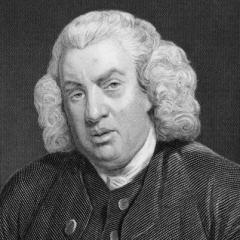
Samuel Johnson
Samuel Johnson was an English writer, poet, and lexicographer, renowned for his comprehensive English dictionary, 'A Dictionary of the English Language', published in 1755. His distinctive writing style and wit have cemented his place as a significant figure in the history of English literature. more
You May Also Like
“Perhaps man is the only being that can properly be called idle.”
Source: The Rambler (1750-'52) a. the Idler (1758-'60)
Source: Samuel Johnson: Selected Writings
Source: The life of Samuel Johnson, LL. D., comprehending an account of his studies, and numerous works, in chronological order: a series of his epistolary correspondence and conversations with many eminent persons; and various original pieces of his composition, never before published; the whole exhibiting a view of literature and literary men in Great Britain, for near half a century during which he flourished
Source: Johnsoniana; or supplement to Boswell; being Anecdotes and sayings of Dr. Johnson, etc
Source: The Rambler: A Periodical Paper, Published in 1750, 1751, 1752
Source: The Life of Johnson: with Maxims and Observations: Moral, Critical, and Miscellaneous, Accurately Selected from the Works of Dr. Samuel Johnson, and Arranged in Alphabetical Order