Quotessence
Home / Quotes / Quote by John Steinbeck

Quote by John Steinbeck

“It seems to me that if you or I must choose between two courses of thought or action, we should remember our dying and try so to live that our death brings no pleasure to the world. We have only one story. All novels, all poetry, are built on the never-ending contest in ourselves of good and evil.”

Quote by John Steinbeck

Author
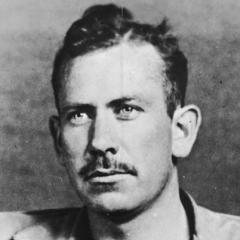
John Steinbeck
John Steinbeck

John Steinbeck was an American author renowned for his profound depiction of American society and the lives of farmers. His works often explore themes of poverty, social injustice, and human nature. Steinbeck was awarded the Nobel Prize in Literature in 1962 for his significant contribution to American literature. more

You May Also Like

“An especially close friend inquired ‘is it that you’re afraid you’ll never see England again?’ As it happens he was exactly right to ask, and it had been precisely that which had been bothering me, but I was unreasonably shocked by his bluntness. I’ll do the facing of hard facts, thanks. Don’t you be doing it too . . . ‘Yes, I suppose a time comes when you have to consider letting go.’ How true, and how crisp a summary of what I had just said to myself. But again there was an unreasonable urge to have a kind of monopoly on, or a sort of veto over, what was actually sayable. -Mortality”

“Gratitude needs practice, though. Gratitude for the things that don't seem to help, that aren't sought out or welcome-that's a demanding kind, and it is needed in hard times. A book about dying should have that kind of gratitude in it, bleeding through from the other side of sorrow. Drink enough of the sweet, strong mead of grief and love for being alive and it isn't long before you're sending a trembling, life-soaked greeting out to everything that came before you and to everything that will follow, a kind of love letter to the Big Story.”

“Dying wise: That's that antidote. Dying wise is the rumor around which all the attempts to control and manage and detoxify and assuage and domesticate and diminish dying swirl in our corner of the world. Dying wise is a thought unthought-a rumor-in a culture that does not believe in dying, and it will take about as much courage and wisdom as you can manage to do it. Dying wise is a life's work. Dying wise is the Rhythm, the Story, around which human life must swirl.”

“Cost-effectiveness is the screw that turns the wheel of efficiency. But there is a considerable cost to pursuing cost-effectiveness. Here is the logarithm of progress: The more you pursue being saved from the drudgery of going through your days, the ordinariness of being around, the venality of physical limitation or vulnerability, the more is taken from the physical world to provide you that salvation and the more remote you will be from what grants you your security. That is an ecological and spiritual fact.”

“Our lowest infant mortality rate is bought in part by obliging infants with considerable birth abnormalities who would otherwise have died from them to live with them instead, often well into their childhoods and beyond, and by asking their families to learn how to do that. Our superb life span is purchased in part by extending old people's lives far beyond what their illness or their disease would have allowed, while still not entirely ridding them of that illness or disease. We should add a fourth record to the string of our achievements: I suspect that we also die the longest. We are not allowed to die on schedule. Often we do, but it isn't encouraged.”